

The AI Productivity Cycle: When Does Enterprise Spending Turn Into Earnings?
July 7, 2026
The question dividing Wall Street in 2026 isn’t whether AI is real — it’s whether the earnings to justify current stock prices will actually show up, and on what timeline. That gap between capital spent today and cash flow generated tomorrow is what we might call the AI productivity cycle, and understanding where we sit in it matters enormously for anyone holding tech-heavy portfolios.
While there are still skeptics who might call it an AI bubble, the differences between the ‘dot-com bubble’ of 2000 and today are stark. While most companies in the dotcom bubble did not have a revenue stream to speak of, today’s major harbingers of AI have extremely healthy revenue streams and profitability well above the S&P 500 average. On the other hand, the ‘dotcom-washing’ of the 2000s is eminently comparable to the ‘AI-washing’ we are seeing today. If adding a mere .com could lead to an ‘irrational exuberance’, then adding the ‘AI-prefix’ without substance has become the leitmotif for many a tech vendor today.
The Spending Side Is Undeniable
However, Enterprise AI investment has moved decisively past the experimentation phase. Oxford Economics forecasts that AI-based product spending in the US will grow to over $1.75 trillion by 2030, roughly 22% of total enterprise tech spend, up from about $230 billion today, with annual growth rates staying above 30% through 2028.1
Source: NVIDIA Company Blog2
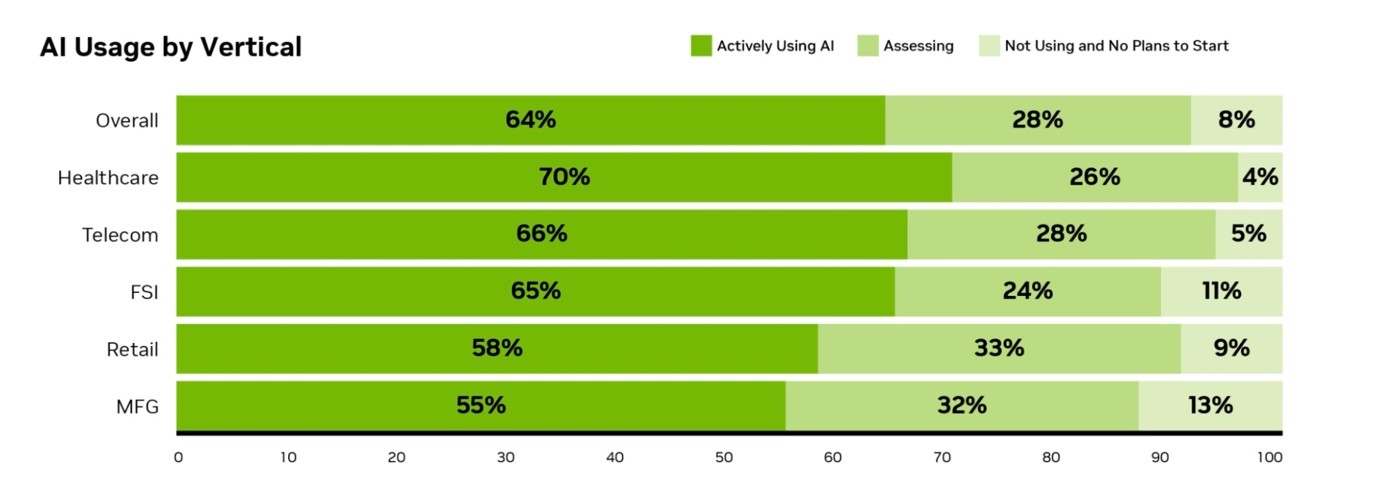
Adoption metrics back this up: NVIDIA’s 2026 industry surveys found 86% of respondents expect their AI budgets to increase this year, with nearly 40% expecting increases of 10% or more, and 64% of organizations now say they’re actively using AI in operations rather than merely piloting it.3 Hyperscaler capex tells a similar story — analysts expect Alphabet, Amazon, Meta, Microsoft, and Oracle to spend roughly $2 trillion combined on AI infrastructure by 2030.4
The Earnings Side Is Lagging
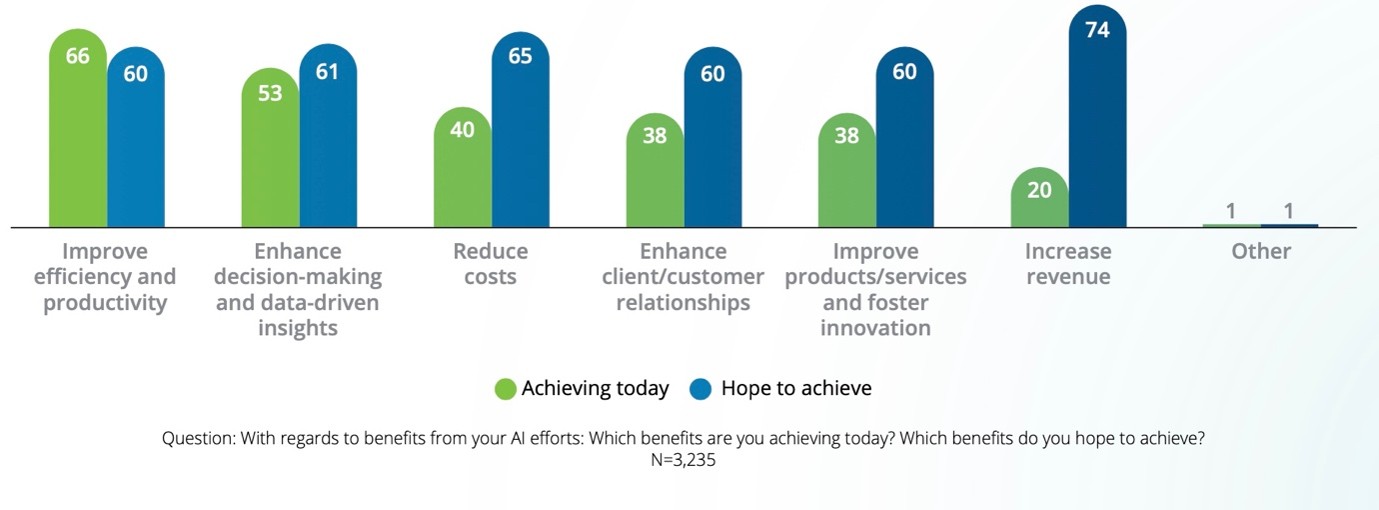
The foremost question on everybody’s mind is – what exactly is the return that enterprises are getting from an outsized AI budget? By and large, spending has outpaced measurable financial return. Deloitte’s 2026 enterprise survey found two-thirds of organizations report productivity and efficiency gains, but revenue growth from AI “largely remains an aspiration” — 74% of organizations hope to grow revenue through AI, versus just 20% who say they already are.5
Source: Deloitte6
A National Bureau of Economic Research working paper published in February 2026 sharpened this concern considerably: despite widespread AI deployment, 90% of firms reported no measurable productivity impact, even though executives themselves projected AI would lift productivity by only about 1.4% and output by 0.8% — modest figures that still haven’t materialized broadly.7
Is the Market Pricing This Correctly?
Not everything is discouraging. IDC and Microsoft have measured a 3.7x average return per dollar invested in generative AI in specific deployments, and companies like Microsoft and ServiceNow are showing real, attributable revenue growth: Microsoft 365 commercial cloud revenue rose sharply on Copilot adoption, driven in part by Copilot and E5 upgrades, and ServiceNow guided full-year 2026 subscription revenue up roughly 20.5–21% year over year.8,9
The pattern that emerges is uneven — narrow, well-scoped deployments (coding assistants, customer support, workflow automation) are showing real returns, while broad, enterprise-wide “transformation” claims remain mostly aspirational.
This is where opinion sharply diverges. Goldman Sachs and JPMorgan argue current valuations are justified by real profit growth and note that forward P/E ratios for large AI companies remain well below dot-com-era peaks.10 Fidelity’s research likewise points out the S&P 500 is on pace for roughly ten consecutive quarters of earnings growth, with double-digit gains expected across all eleven sectors in 2026.11
But the skeptics have real data behind them, too. Market concentration has reached levels beyond the dot-com peak, with the top 10 S&P 500 stocks representing about 35% of the index compared to 25% at the 2000 top. Some AI-exposed companies trade at forward revenue multiples of around 22x, versus 7x for the broader index, and certain names have reached price-to-sales ratios above 30 — a level that has historically preceded sharp corrections.12
Many AI applications promise productivity gains not yet visible in broader economic data, and a June 2026 market wobble comprising a Nasdaq slide, a KOSPI trading halt, and a brutal week for Oracle shares just showed how quickly sentiment can turn when infrastructure spending outruns visible payback.13
What This Means for Investments
For investors, the practical takeaway is that “AI exposure” is not a single, uniform bet — it’s a spectrum of risk depending on where a company sits in the productivity cycle:
- Infrastructure providers (chips, cloud, data centers) are capturing spending now, largely regardless of whether enterprise customers ever see ROI. Their earnings are more directly tied to capex cycles than to end-user productivity gains, which makes them vulnerable if hyperscalers ever pause spending growth.
- Software and application companies with demonstrated, attributable AI revenue (Copilot-driven Microsoft 365 growth, ServiceNow’s agentic workflows) offer a more grounded thesis, since their gains are traceable to actual customer adoption rather than narrative alone.
- Broad market indices are increasingly concentrated in AI-linked names, meaning diversification benefits investors may assume they have are thinner than they appear — a small number of earnings misses could move the whole index.
- Capital discipline and financing structure matter. Fidelity notes that, unlike the dot-com era, most AI capex today is funded from operating cash flow rather than debt, which is a genuine structural difference — but that gap is narrowing as some hyperscalers turn to debt and equity issuance to keep pace with spending demands.14
- Watch leading indicators rather than headlines: revenue-per-employee at AI-exposed firms, the spread between infrastructure capex and enterprise AI revenue realized, forward P/S multiple trends, and whether agentic AI project cancellation rates rise or fall.
Semi-Final Word
It will be years before anyone can decide whether the current AI boom (we are not calling it a hype) is sustained or just another passing storm. One thing is clear – AI today is poised to create a structural shift in the global economy. As usual, the answer will not be binary; it will require a more nuanced approach to AI investments. What we are seeing currently are early stages of evolution. Whether it leads to a healthy baby or one that is stunted will depend upon the real value that enterprises are able to draw from their investments. Early indicators suggest that some of the current big names may flail and new ones will grow. However, the technological juggernaut unleashed is unlikely to stop any time soon.
The final word is out there… way out there.
Sources:
2. https://blogs.nvidia.com/blog/state-of-ai-report-2026/
3. Ibid.
6. Ibid.
10. https://intellectia.ai/blog/ai-investment-bubble-2026
11. https://www.fidelity.com/learning-center/trading-investing/ai-bubble
13. https://fortune.com/2026/06/08/ai-boom-tech-stocks-bubble-fears-earnings-growth-chipmakers-ipo/
14. https://www.fidelity.com/learning-center/trading-investing/ai-bubble