

The “Power Premium”: Why Access to Electricity Is Becoming a Critical Determinant of Investment Value
July 29, 2026
For decades, investors treated electricity as a utility input – necessary, but rarely a source of strategic differentiation. That assumption has now become obsolete. The explosive growth of artificial intelligence, electrified manufacturing, data centers, and energy-intensive infrastructure is creating what can be called a ‘Power Premium’: assets with reliable, scalable, and affordable electricity access are commanding materially higher investment value than comparable assets without it. Consequently, the primary risk for a data center has shifted from IT hardware to access to power, the focus being on grid reliability, exacerbated by interconnection queues in the US extending inexorably and the realization that grid upgrades involve multi-year and sometimes even a decadal timeline.
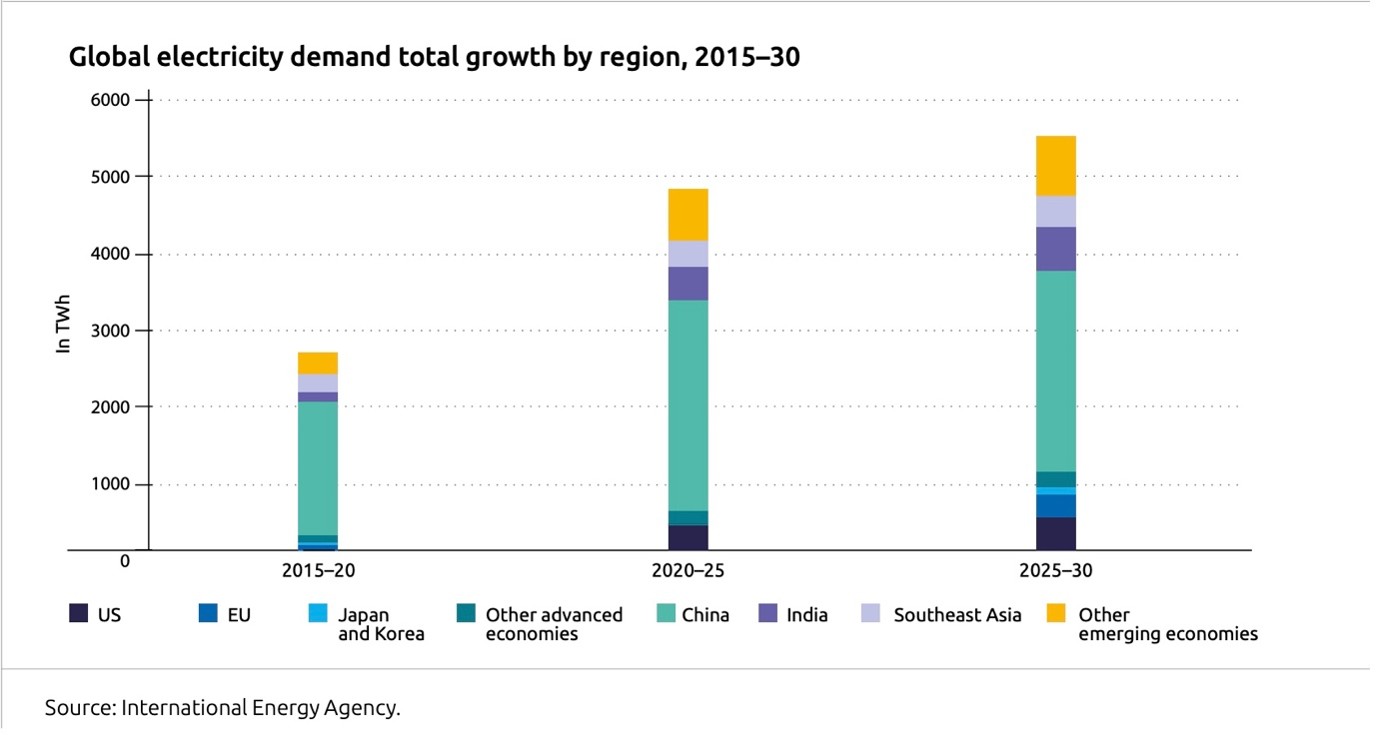
Source: Capgemini1
From AI campuses in the United States to semiconductor fabrication plants in Asia and Europe, access to power is emerging as a binding constraint on growth. In some regions, developers are discovering that obtaining a grid connection can take longer than constructing the facility itself. For hedge funds, private equity firms, infrastructure investors, and real estate funds, electricity availability is increasingly becoming a core underwriting variable rather than an operational afterthought.
The Structural Shift In Power Demand
The International Energy Agency (IEA) projects that global electricity demand from data centers, AI, and cryptocurrency could more than double by 2026, with AI-driven workloads becoming a major contributor to incremental demand. The IEA also notes that data centers are among the fastest-growing sources of electricity consumption globally. In addition, the electrification of the transportation sector and surge in semiconductor manufacturing capacities are adding to the demand for power across the US, Europe and Asia.
The result is a competition for power capacity among technology companies, manufacturers, utilities, and real estate developers. Power access is moving from an operational input to a valuation driver across AI infrastructure, industrial reshoring, and strategic real estate.
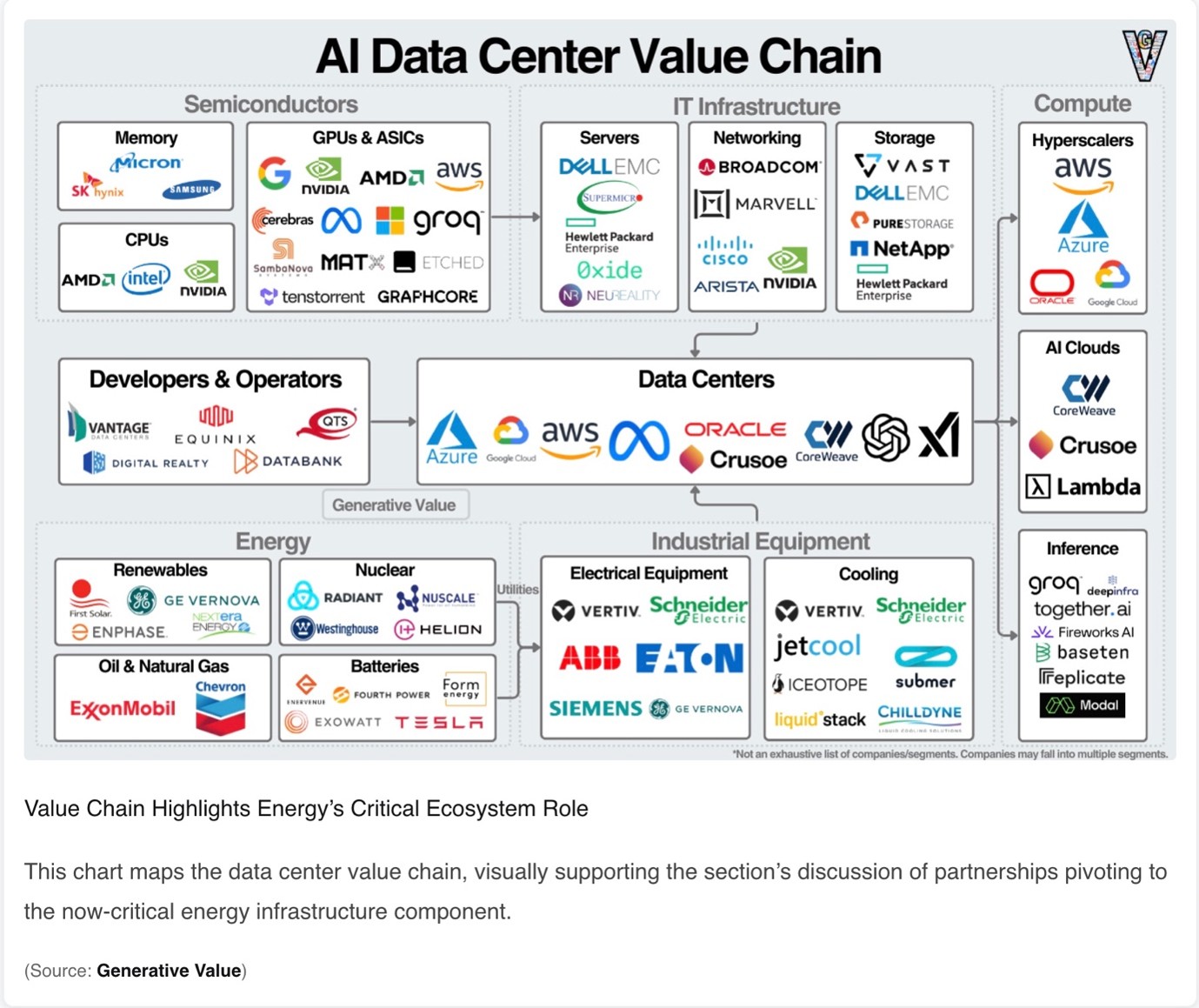
Source: Enki2
Why This Repriced Risk Creates Real Opportunity
In the world of finance, scarcity has a price, and it’s already showing up in wholesale markets. Given that the demand for power is growing at unprecedented levels and the supply thereof is going to be the real constraint, Morgan Stanley notes that as operators race to secure dedicated generation, power spreads – the gap between the price electricity sells for and the cost to generate it – could rise by 15%, potentially creating $350 billion of value across the power supply chain.3 That’s a direct read-through to independent power producers, grid-equipment makers, and on-site generation providers.
AI Infrastructure: Power Is The New Alpha For Investors
Large AI models require enormous computing clusters. A single hyperscale AI data center can require hundreds of megawatts of electricity-equivalent to the consumption of a medium-sized city. While Microsoft, Amazon, Google, and Meta have all announced multibillion-dollar investments in AI infrastructure, many of these projects now face delays due to transmission bottlenecks and limited grid capacity.
Premium assets will attract a higher valuation. This includes land with existing high-voltage grid connections, sites near transmission infrastructure, data centers with contracted power supply, and assets paired with renewable generation and storage. On the other side, projects dependent on future grid upgrades, location-facing transmission congestion, and assets exposed to curtailment risk (typically prevalent in renewables) will be seen as risky bets and will be subject to discounts.
Manufacturing & Industrial Reshoring
The semiconductor and advanced manufacturing sectors provide another example of the Power Premium.
Modern chip fabrication plants require continuous, highly reliable electricity. The U.S. CHIPS and Science Act has triggered a wave of fab investments, but utilities and regulators have increasingly warned that power infrastructure must expand in parallel.
Similarly, battery factories and electric-vehicle supply chains are among the most electricity-intensive industrial facilities being built today. Investors evaluating industrial parks, logistics hubs, or manufacturing clusters must now assess:
- Available megawatt capacity
- Time to grid connection
- Renewable energy procurement options
- Transmission expansion plans
- Long-term electricity pricing
In several markets, power availability has become a more important site-selection criterion than manpower costs or tax incentives.
Real Estate: Location Is No Longer Enough
As a result, the valuation spread between “power-ready” and “power-constrained” properties is likely to widen over the next decade.
Traditionally valued on location, transportation access, and tenant demand, industrial and data center developers are paying substantial premiums for parcels that already have grid interconnection rights. In contrast, otherwise attractive land may remain undeveloped for years if power delivery cannot be secured.
The Investment Thesis
In the next 3–5-year horizon, electricity scarcity will create differentiated winners across infrastructure, utilities, real estate, and industrial supply chains.
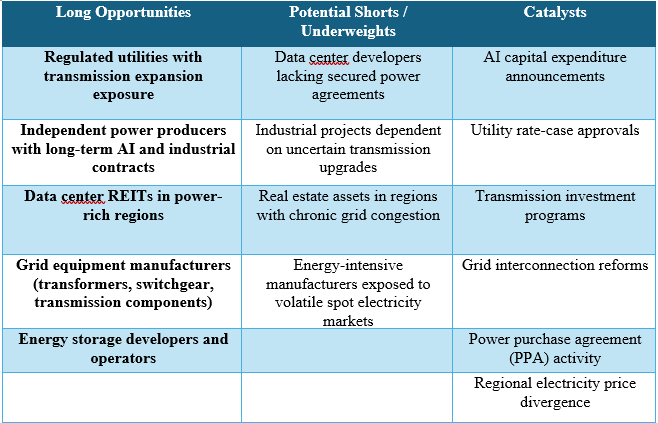
Source: Rostrum Grand research
Why Investors Should Care
Historically, investors analyzed real estate and infrastructure through the lens of location, labor, logistics, and regulation. A fifth variable-electricity availability-is becoming equally important.
The market is beginning to recognize that power is not merely a commodity; it is a strategic asset. Regions with abundant generation, modern transmission networks, and fast interconnection processes are likely to attract disproportionate shares of AI investment, advanced manufacturing, and digital infrastructure.
In that environment, the “Power Premium” may become one of the defining investment themes of the next decade. Assets that can reliably deliver megawatts when the economy increasingly runs on electrons rather than hydrocarbons are likely to command higher valuations, stronger occupancy, and superior long-term returns.
For hedge funds and long-term investors alike, the key question is no longer “How much power does this asset consume?” but “How difficult will it be to obtain the power it needs?” The answer to that question may determine the next generation of investment winners.
Sources:
1. https://www.capgemini.com/wp-content/uploads/2026/06/CRI_Data-centers_V10_interactive.pdf
2. https://enkiai.com/data-center/data-center-power-crisis-2026-the-grid-bottleneck/
3.https://www.morganstanley.com/insights/articles/powering-ai-energy-market-outlook-2026