

Democratizing Private Equity: What Retail Access Through Evergreen Funds Really Means
August 3, 2026
For decades, private equity was a members-only club. Institutions and ultra-high-net-worth families committed capital for ten-plus years, endured J-curve losses in the early going, and waited patiently for distributions. Individual investors were, for the most part, locked out — not by choice, but by structure: traditional drawdown funds require million-dollar minimums, multi-year lockups, and the operational sophistication to manage capital calls.
That is changing quickly. Evergreen funds — perpetual-life vehicles that let investors subscribe and redeem on an ongoing basis rather than waiting for a fund to wind down — have become the primary bridge between private markets and everyday portfolios. The scale of this shift is hard to overstate. According to Morningstar PitchBook (quoted in a Wealth Management blog), the U.S. evergreen fund universe grew to $607 billion across 567 funds as of March 2026, up from $590.8 billion a year earlier, and wealth-focused evergreen vehicles have more than quadrupled over the past decade to roughly $427–430 billion in AUM.1 PitchBook’s base case projects this segment could surpass $1.1 trillion by 2029. Fund launches hit a decade high in 2025, with 123 new evergreen vehicles introduced and private equity and private debt as the most active categories.
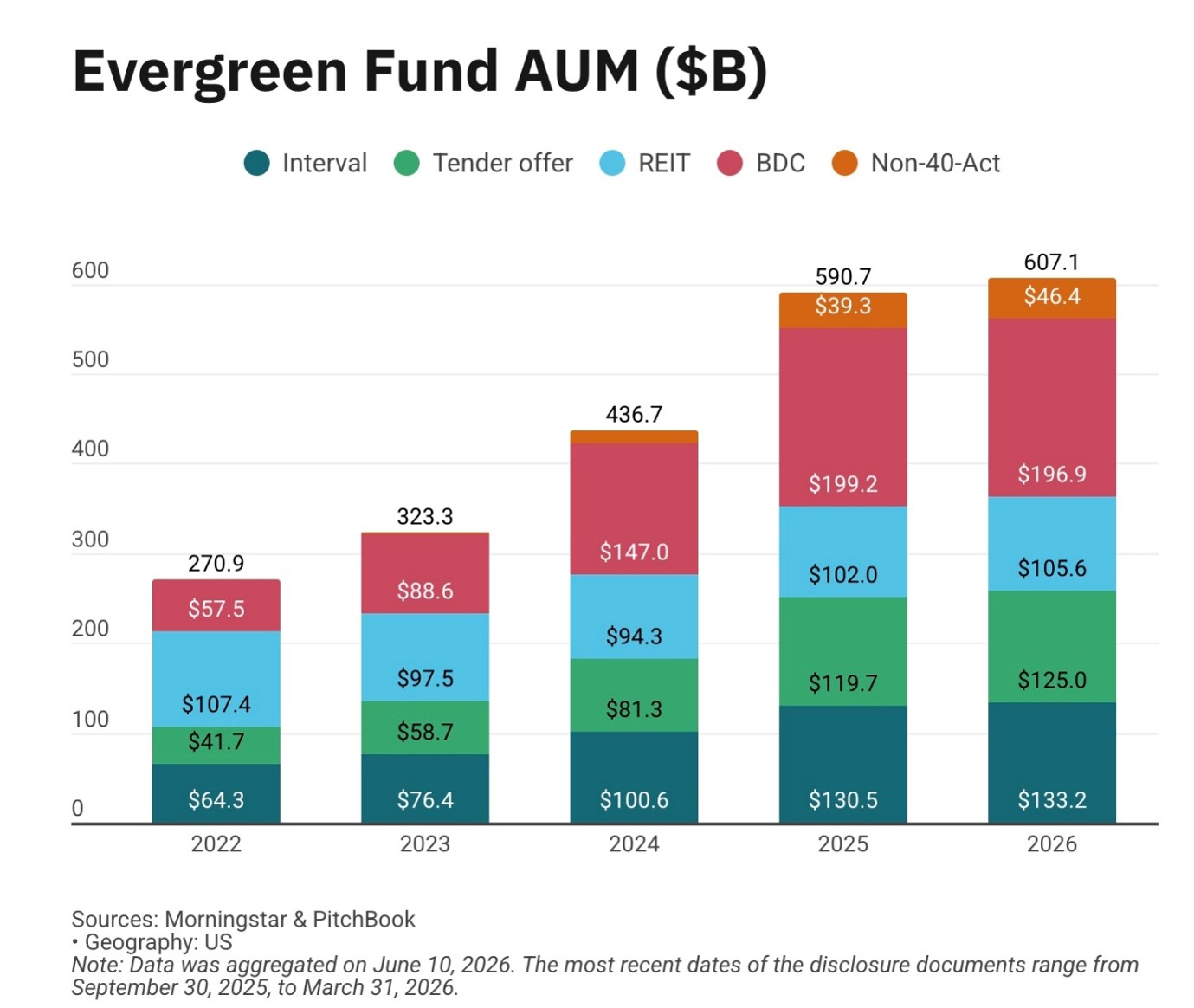
Source: Wealth Management by Informa2
How the Access Actually Works: Interval Funds vs. Tender Offer Funds
Retail access almost always runs through one of two SEC-registered closed-end fund structures, both of which allow funds to hold illiquid private assets well beyond the 15% illiquidity cap imposed on traditional open-end mutual funds.
- Interval funds, governed by Rule 23c-3, commit contractually to repurchasing between 5% and 25% of outstanding shares at NAV on a fixed schedule — quarterly is the norm, with roughly 90% of interval funds setting the offer at the 5% minimum. If redemption requests exceed the offered amount, shares are repurchased pro rata, meaning an investor might only get a fraction of what they asked to redeem back in any given window
- Tender offer funds, by contrast, operate under Rule 13e-4 of the Exchange Act and repurchase shares at the board’s discretion rather than under a binding formula. This gives managers more flexibility to time liquidity around actual portfolio conditions, but it also means investors have a less predictable — and non-contractual — path to cash. Notably, neither structure typically requires accredited investor or qualified purchaser status, which is precisely what has opened the door to a much broader investor base.
The Real Trade-Offs
The democratization case is genuinely compelling, but it comes with structural trade-offs worth understanding rather than glossing over.
- Liquidity is real, but it is rationed, not guaranteed. The redemption mechanics above exist precisely because the underlying assets — private companies, real estate, direct loans — cannot be sold quickly without destroying value. In periods of elevated redemption demand, funds can and do gate: investors tender more than the 5–25% ceiling, and requests get scaled back pro rata. Industry researchers have flagged this explicitly, noting that advisors and investors “should be prepared for the fact that the semiliquid funds they allocated money to will, at some point, experience a liquidity crunch,” and should understand in advance how a manager plans to handle it. Even so, the most recent data is encouraging: private-equity-focused interval and tender offer funds posted the strongest net inflows of any sub-sector in the year through March 2026, at $16.3 billion, with only real estate evergreens seeing modest net outflows.3
- Cash drag cuts against continuous entry. Unlike a drawdown fund, which calls capital only as deals are found, an evergreen vehicle must keep a liquidity sleeve on hand to meet redemptions and stay invested for new subscribers simultaneously — a structural tension that can modestly dilute returns relative to a fully-invested, closed-end vintage.
- Dispersion matters more than the headline return. MSCI’s research on evergreen benchmarks makes an important point: because no investor can realistically own the entire private markets universe, the spread between top- and bottom-performing funds is often more consequential to an individual’s outcome than the pooled or median return figure — manager selection still matters enormously, even in a semiliquid wrapper.
- Fees are continuous. Evergreen structures charge management and often performance fees on an ongoing basis, with no wind-down and no gap between vintages — which is part of why asset managers have been so eager to build out this channel, and part of why investors should scrutinize the full fee stack rather than compare it directly to a closed-end fund’s fee schedule.
Closed-End vs. Evergreen Funds: Two structures, two liquidity profiles, two investor experiences
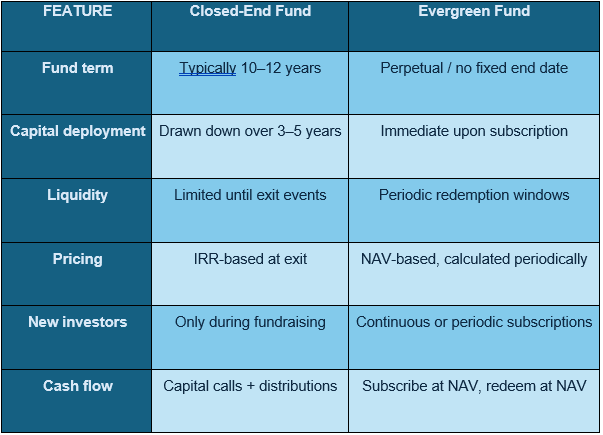
Source: Augment Markets Research4
The Bigger Picture
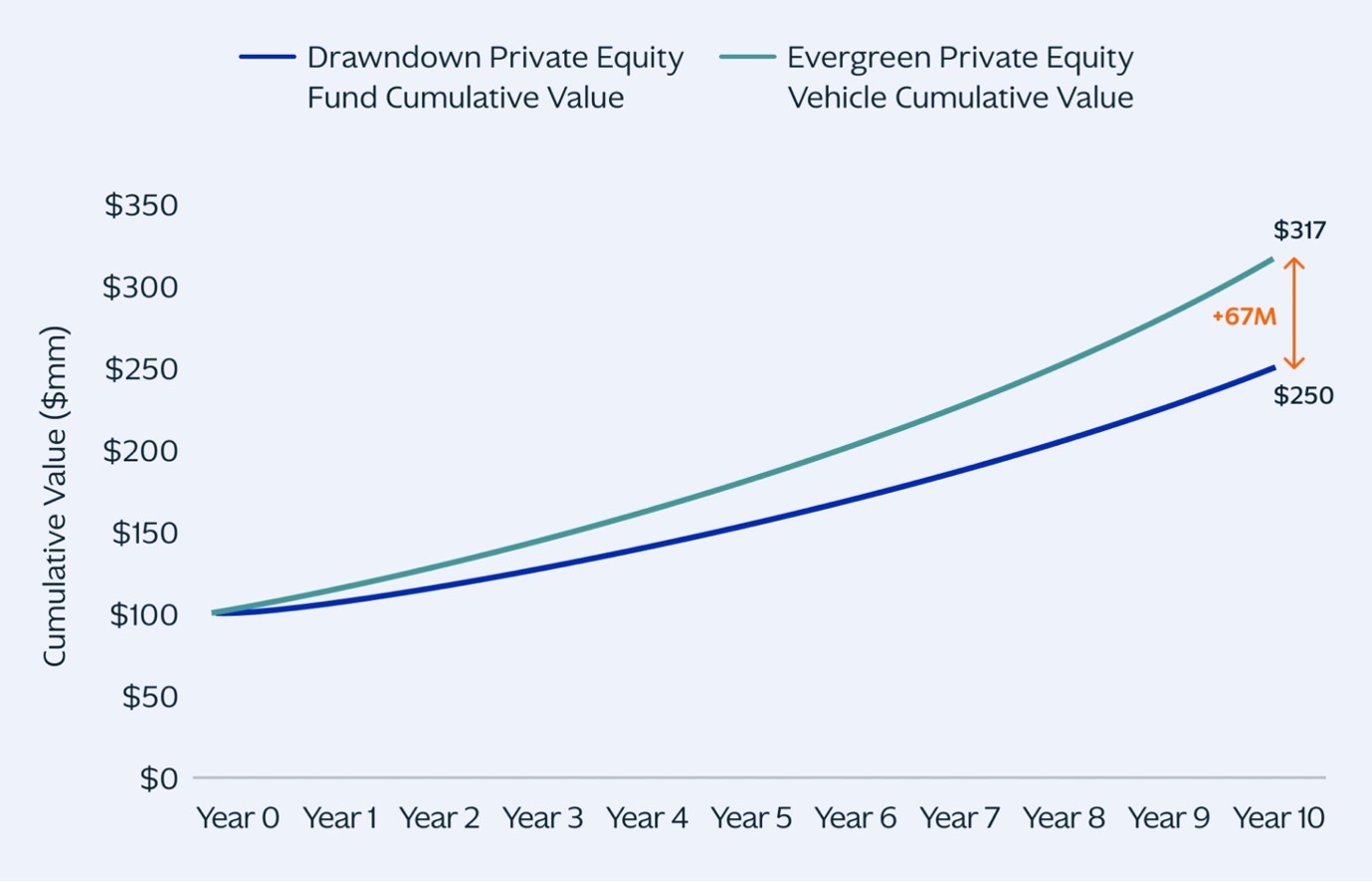
None of these trade-offs are disqualifying – they’re the price of admission for a genuinely useful innovation. Evergreen structures have, for the first time, given individual investors meaningful, diversified exposure to an asset class that has historically delivered return premiums difficult to fully capture through public markets, without demanding the operational burden of managing capital calls or the multi-million-dollar minimums that kept the door shut for so long. An analysis by KKR showed that an individual investor can potentially achieve a higher compounded return in an evergreen fund as against a drawdown fund.
Cumulative value of investing $100 in evergreen funds and drawdown funds for 10 years
Source: KKR5
While the above is purely illustrative, the inherent advantages of the evergreen funds have the potential to deliver higher returns, especially in volatile markets.
The next frontier may be even larger. According to Dakota Marketplace, U.S. defined-contribution retirement plans hold roughly $12.2 trillion in assets with almost no private markets exposure today, and a Department of Labor rule proposed in March 2026 would make it easier for 401(k) sponsors to add evergreen funds without additional fiduciary liability.6 Even a 2% allocation shift in target-date funds could bring in $244 billion: more than the entire current wealth-channel evergreen market combined.
For investors already in these vehicles, the practical takeaway is straightforward: understand which structure you own (interval vs. tender offer), know the actual mechanics of your redemption window, and treat liquidity as a feature to be used thoughtfully rather than assumed. Evergreen funds have earned their growing share of the private markets conversation: the opportunity is real, and so is the discipline required to use it well.
Sources:
2. Ibid.
3. Ibid.
4.https://augment.market/manual/evergreen-funds
5. https://www.kkr.com/insights/evergreen-vehicle