

Backwardation, Contango, and Roll Yield: Why Commodity Futures Returns Aren’t What They Seem
August 11, 2026
Imagine tracking crude oil prices, seeing oil surge by 30% over six months, checking your commodity ETF, and discovering your investment barely broke even.
New investors often assume that buying commodity exposure is straightforward: if oil goes up, your oil investment goes up and vice versa. Here is the catch. Investors don’t buy barrels of oil or bushels of wheat – they buy futures contracts, or funds that hold futures contracts. And futures returns can diverge sharply from spot price movements because of a structural force most people have never heard of: roll yield.
Futures contracts have expiration dates, and at any given time, several contracts for the same commodity trade simultaneously – one expiring next month, another in three months, another in a year. This process-known as “rolling”-introduces structural dynamics that can either supercharge your portfolio or quietly erode your capital. Understanding three core concepts—Contango, Backwardation, and Roll Yield—is essential to mastering commodity futures performance.
When futures prices sit above the spot price, the market is in contango; when futures prices sit below the spot price, it’s in backwardation. A futures contract must equal the spot price by its final trading day, whether through cash settlement or physical delivery – this convergence is what drives the entire dynamic.
Understanding the Forward Curve: Contango vs Backwardation
The relationship between immediate spot prices and future contract prices across time creates a shape known as the futures curve or term structure.
Contango (Upward Sloping)
A market is in contango when futures prices are higher than the current spot price, and longer-dated contracts cost more than near-dated ones.
- Why it happens: Physical storage, insurance, transportation, and cost-of-carry finance add expenses over time.
- The Impact: When you roll an expiring contract into a more expensive future month contract, you are effectively “buying high.” Over time, as that contract approaches expiration, its price naturally converges down toward the spot price. This downward price pull creates a persistent negative roll yield
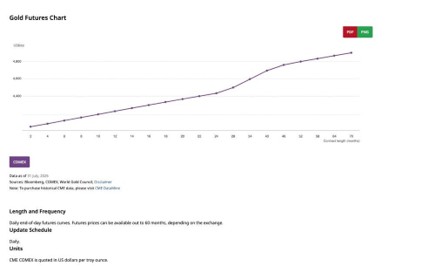
The following is the forward curve of Gold as of July 31, 2026, as per the World Gold Council, which exhibits Contango
Backwardation (Downward Sloping)
A market is in backwardation when futures prices are lower than the spot price, and far-dated contracts are cheaper than near-dated ones.
- Why it happens: Near-term supply shortages or high convenience yield-the implicit economic benefit of physically holding inventory immediately-cause buyers to pay a premium for immediate delivery.
- The Impact: When rolling forward, you sell the expiring contract at a higher price and purchase the next month’s contract at a discount. As the lower-priced contract converges upward toward the spot price at expiration, it generates a positive roll yield.
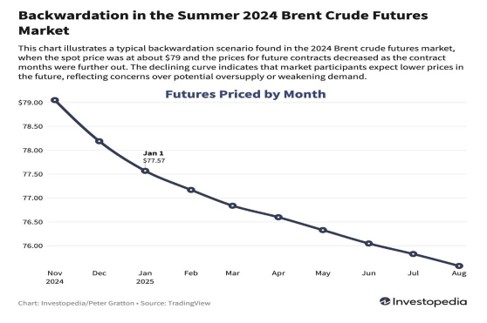
Source: Investopedia2
Because a fund can’t hold a contract to physical delivery, it has to “roll” – sell the expiring contract and buy the next one – before expiration to maintain exposure. A roll means selling an expiring or nearby contract and buying a longer-dated one to maintain exposure to the commodity. This mechanical act of selling low and buying high (or vice versa) is where roll yield comes from.
For a long investor, roll yield is positive in backwardation, when nearby prices exceed deferred prices, and negative in contango, when deferred prices exceed nearby prices. In backwardation, the investor sells the (higher-priced) expiring contract and buys more of the (lower-priced) deferred contract to maintain the same dollar exposure: a favorable trade. In contango, the reverse happens: the fund sells low and buys high every single roll period, and if the spot price stays flat, a contango-based ETF will exit each futures contract at a lower price than it entered it, losing money month after month.
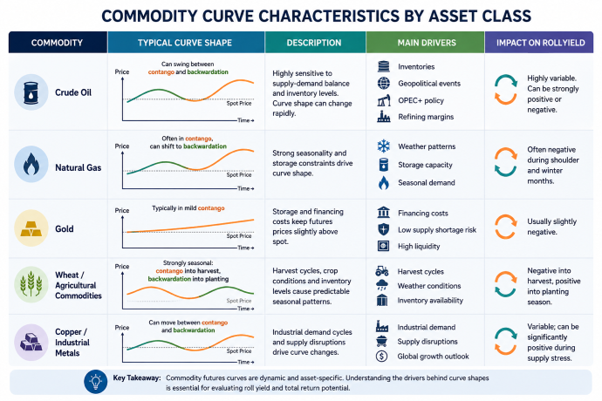
Source: Rostrum Grand research
Three Components, Not One
This is arguably the most important reframe for new commodity investors: total futures return isn’t a single number; it’s the sum of three distinct engines. Collateral return, or collateral yield, is the interest earned on the cash or cash-equivalent assets used to collateralize a futures position. Add that to spot price return and roll yield, and you get the full picture: total return equals spot return, the percentage change in the underlying commodity price, plus roll yield, the gain or loss from rolling futures contracts based on curve shape, plus collateral return, the interest earned on posted margin.
This is why an investor can be right about the direction of a commodity’s spot price and still lose money in a futures-based fund – or be wrong about spot and still profit, if roll yield is strongly positive.
Roll return is the profit or loss generated when an investor rolls an expiring futures contract into a longer-term one. In a backwardated market, futures prices trade below the expected spot price. As a result, investors can buy longer-dated contracts at a discount. As these contracts approach expiration, their prices naturally rise to converge with the higher spot price, producing a positive roll return.
Conversely, a negative roll return occurs in a contango market, where futures trade above the spot price. Here, investors repeatedly sell expiring contracts at lower prices and buy new ones at higher prices, losing money on the roll.
Why This Surprises People
Steep contango generally signals that supply is adequate – “there’s no urgency, we have plenty” – while persistent backwardation tends to signal a tight physical market where consumers need the product now and are willing to pay a premium for immediate delivery. Oil, for instance, often trades in contango because of high storage costs, financing expenses, and abundant supply, with futures prices rising to reflect the cost of carrying oil until delivery.
Most retail investors don’t check the shape of the futures curve before buying a commodity ETF – they just look at whether they’re bullish or bearish on the underlying commodity. But most of the time, futures curves for commodities are in contango, which means ETFs seeking to benefit from rising prices face a performance drag from negative roll yield, and this drag has been a large contributor to the long-term negative annualized returns posted by many of these products.
The Takeaway
Contango and backwardation aren’t arcane trivia; they’re structural features that can determine whether a “correct” directional bet on a commodity actually makes money. Before buying commodity futures exposure, directly or through an ETF, it’s worth checking the current shape of the curve, understanding which regime a given commodity tends to sit in historically, and remembering that spot price is only one-third of the return equation.
Sources:
1. https://www.gold.org/goldhub/data/gold-futures-curves#from-login=1
2. https://www.investopedia.com/terms/c/contango.asp