

The ABL Renaissance: Why Asset-Based Lending Is Absorbing Bank Retreat in Private Credit
September 10, 2026
As banks pull back from balance-sheet lending under tighter capital rules, non-bank ABL platforms are financing inventory, receivables, and equipment for Mid-market borrowers.
In August 2026, Nvidia signed a broad MoU with six large Wall Street firms to raise more than $500bn (£370bn) to fund the data centers, chip factories and power stations needed to fuel the artificial intelligence boom. As a result, instead of relying on a company’s general credit score, Wall Street firms will lend money to data center operators and tech companies. The loans will be directly secured by the physical AI assets being bought—specifically Nvidia’s high-end chips, hardware, and data center infrastructure.
This is a textbook example of Asset-Based Financing, which has grown steadily but has exploded behind the AI infrastructure boom and has now become a centerpiece of private lending strategies.
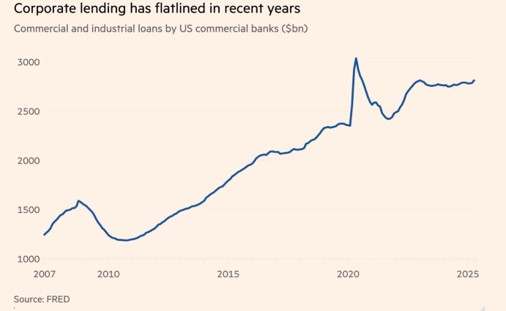
To understand the nuances behind the rapid growth in Asset-Based Lending (ABL), you have to go back to the spate of regulations that followed the GFC in 2008. Dodd-Frank in the US and the Basel regulations in Europe have steadily forced the banks- once the source of lending- to tighten their balance sheets and retreat from riskier corporate lending. This is exemplified by the flatlining of Commercial & Industrial (C&I) lending in the US in recent years.
The Nature of the Beast
An ABL transaction typically starts with a borrowing base. The lender determines which assets qualify as collateral, assigns advance rates, and monitors the value and quality of the asset pool.
For example, a lender might finance a percentage of eligible receivables, with a lower advance rate against inventory because inventory can be harder to liquidate. Equipment finance may be structured around the machinery’s resale value and useful life.
The investment appeal lies in the possibility of multiple layers of protection:
- Collateral coverage: The lender has a claim on specific assets.
- Borrowing-base discipline: The amount available can adjust as collateral values change.
- Diversification: A pool of receivables may represent many customers rather than a single corporate obligor.
- Structural protections: Covenants, reporting requirements, cash dominion, and other controls can support monitoring and recovery.
These protections do not eliminate risk. Receivables can be disputed or concentrated. Inventory can become obsolete. Equipment values can fall. Fraud, weak controls, and poor collateral reporting can undermine an apparently secured loan.
Nevertheless, ABL shifts the underwriting conversation from “How much debt can this company service?” toward “What is the value of the collateral, how quickly can it be monetized, and how much financing can it safely support?” That distinction can be powerful for private credit investors.
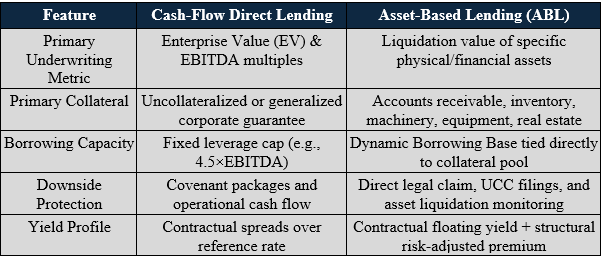
Cash Flow Direct Lending Vs ABL
To understand why non-bank ABF is absorbing this retreat, it is essential to compare traditional cash-flow-based private credit with collateralized lending.
Source: Rostrum Grand research
ABL and the Mid-Market Play
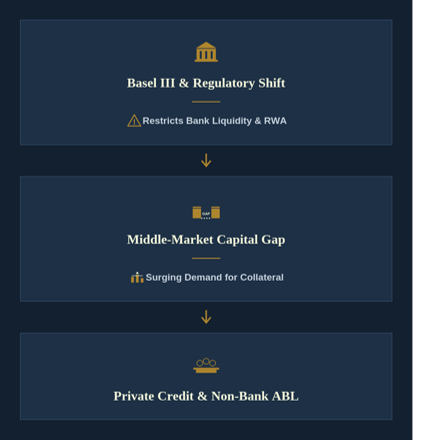
This trend has affected mid-market companies, many of which may not have the heft to tap public debt markets. Mid-market companies have substantial financing needs, valuable operating assets, and often fewer financing alternatives than large corporations. As banks become more selective, specialist ABL lenders can provide the working capital that keeps these businesses growing.
For mid-market borrowers, regulatory demands can create a frustrating financing environment: banks remain important but may be unwilling to provide the size, flexibility, or duration of facility required. A manufacturer needs working capital against inventory. A distributor needs a revolving line against receivables. An equipment-intensive company needs financing against machinery.
These are not necessarily businesses with weak economics. Their funding needs may no longer fit a regulated bank’s preferred lending model. As a result, mid-market companies face tighter credit limits, shorter terms, or outright rejections. Non-bank private credit funds are stepping up to bridge this gap.
Source: Rostrum Grand research
Mid-market companies in capital-intensive sectors-such as manufacturing, distribution, retail, and logistics-require continuous liquidity to support working capital cycles. Non-bank ABL structures provide liquidity customized to these operational needs:
- Accounts Receivable Financing: Converts trade invoices into immediate cash flow, enabling businesses to fulfill sales cycles without waiting 30/60/90 days for buyer settlements.
- Inventory Lines: Provides credit lines to purchase raw materials or buffer finished goods, scaling dynamically as working capital requirements peak seasonally.
- Equipment Term Loans: Unlocks capital from long-term heavy machinery, transportation fleets, or specialized hardware.
Unlike rigid traditional bank lines that force restrictive financial covenants, non-bank ABL platforms evaluate asset velocity, inventory turnover, and customer concentration. This flexibility allows asset-rich borrowers to access vital liquidity even during earnings volatility.
Reshaping Private Credit Strategies
The expansion of ABL is altering how alternative asset managers structure, raise, and deploy capital:
- Strategy Diversification Away from Buyout Beta: Fund managers are reducing their reliance on private equity sponsor-backed M&A deals. ABF allows private debt platforms to target non-sponsored, family-owned, and founder-led businesses.
- Expansion of Asset-Based Finance (ABF) Vehicles: Institutional investors are building dedicated Asset-Based Finance funds. By targeting floating-rate net yields with strong structural protections, asset managers are attracting sovereign wealth funds, pensions, and insurance capital seeking asset-backed income.
- Operational Specialization & Servicing Capability: Unlike passive direct lending, ABF requires active monitoring. Private credit firms are acquiring specialist originators or building in-house field auditing, collateral monitoring, and appraisal teams.
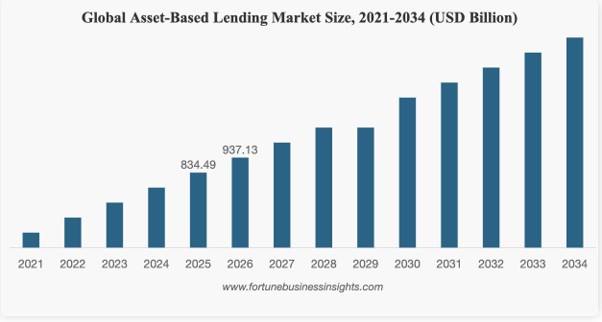
One of the biggest drivers for ABL is likely to be the AI infrastructure boom, which is upending the IT budgets of technology providers as well as enterprises. While the jury is still out on the metrics of AI deployment in enterprises, the sheer capex that is estimated to be spent on building out the ‘compute’, comprising the GPUs, data centers, AI hardware, and adjacent assets such as power, water, etc is going to be significantly driven by non-equity funding. Nvidia’s MoU is simply a harbinger of things to come. In such a scenario, ABF will find fertile ground.
Source: https://www.fortunebusinessinsights.com/asset-based-lending-market-108510
Note: The above estimates were prepared well before the Nvidia-type deals were struck, so the estimates for 2026 and 2027 may be understated.
As traditional banks continue to shed balance-sheet risk, non-bank asset-based lending is evolving from a specialized financing option into a core foundation of modern private credit. By backing Mid-market liquidity with physical collateral, ABL platforms provide essential funding to the real economy while establishing durable structural protection for institutional capital.
Sources:
1. https://www.ft.com/content/b7729107-afb1-4fd7-bfd2-434d1ef7edbb