

News Digest: Oil Stays Above $100 as Logistics Bottlenecks, Not Supply, Drive Prices
October 7, 2026
Middle East crude exports have climbed to their highest levels since the Iran war began, yet oil prices remain stubbornly high. Reuters columnist Ron Bousso argues that logistical problems are now proving as disruptive as outright supply losses.
Crude flows through the Strait of Hormuz reached 14.2 million barrels per day on a seven-day average on September 26, nearly 80% of pre-war levels, according to Kpler. Saudi Arabia, which had diverted exports via its East-West pipeline to the Red Sea, moved them back to Hormuz after Iranian-backed militias attacked the pipeline in early September. Saudi exports through the strait averaged 3 million bpd, the highest of the conflict. Bousso suggests the attack may have weakened Tehran’s leverage by showing large volumes can still transit Hormuz.
The global oil deficit has shrunk to around 1.6 million bpd, from roughly 4 million bpd at the May peak, according to Energy Aspects. Even so, Brent remains more than 40% above pre-war levels. Part of that reflects a risk premium, since Washington and Tehran have reached no understanding on Hormuz.
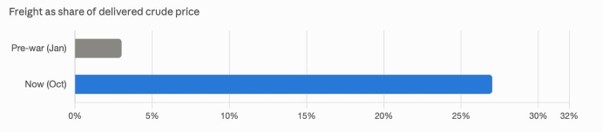
The bigger factor is freight and insurance. A shuttle system requires multiple tankers to move crude to the Gulf of Oman, tying up very large crude carriers, while buyers sourcing Atlantic Basin crude for Asia lengthen routes. Middle East to Asia VLCC rates have topped $1.2 million per day, up from about $30,000 in January. Freight now makes up roughly 27% of a barrel’s delivered price, versus about 3% before. A further recovery in Hormuz exports could initially worsen this by increasing demand for the shuttle networks.
The shift from a supply story to a logistics story opens several angles for hedge funds. Trend-following and macro managers, which already gained in September from long energy and short fixed income positions, may find further momentum if freight and diesel costs keep feeding inflation expectations and rate-hike bets. Relative-value and commodity specialists can target dislocations the bottlenecks create, such as wide diesel crack spreads, gaps between Atlantic Basin and Middle East crude grades, and the premium for medium-sour barrels.
Positions in tanker owners, which benefit from record VLCC rates, or in refiners with diesel-heavy yields, offer equity exposure to the same theme. Event-driven and discretionary funds can trade the geopolitical risk premium, since any US-Iran understanding on Hormuz could quickly deflate prices and punish crowded long positions. The risks are considerable: sharp reversals on diplomatic headlines, volatile freight rates and the possibility that policy responses, such as further strategic stock releases, cap prices abruptly.