

Who Is Getting the Money in H2 2026? Allocator Flows in a Hiking World
October 22, 2026
Second-half allocator flows are being set by two forces that rarely arrive together. Hedge funds are coming off one of their best capital-raising stretches in nearly two decades, and the central banks that spent 2025 easing have turned hawkish.
The H1 baseline: strong, but concentrated
Industry assets reached $5.6tn in Q2. Hedgeweek, citing HFR, reported a record $409.3bn quarterly gain, with $45.2bn coming from net investor inflows.1 Trailing three-quarter inflows of $134.4bn have already topped 2025’s $115.8bn total, which itself was the strongest year since 2007. Performance helped: the HFRI Composite gained 7.5% in H1, its best first half since 2021, with tech-focused equity hedge funds up 19%.
The distribution matters more than the headline. Firms above $5bn took an estimated $38.1bn of Q2 net inflows, mid-sized firms $6.3bn, and sub-$1bn managers just $700 million. Strategy preferences also shifted during the half. In Q1, allocations went mostly to market-neutral equity and managed futures, while redemptions hit multi-strategy, event-driven and equity long/short funds. By Q2, equity hedge was leading asset growth again, and macro assets rose to $857.5bn with $15.9bn of net inflows.2
The H2 intentions: more money, more strategies
Surveys point to acceleration. BNP Paribas’s allocator survey (175 investors, about $1.2tn in hedge fund assets) found that portfolios returned 7.46% in H1 against a 4.80% target, and allocators forecast a further $24.9bn of net inflows in H2, following $26.8 billion in H1.3 The H1 figure was more than double the $10.8 billion recorded by the same group in H1 2025. Equity long/short is the most sought-after strategy, with 35% planning to add. Europe (49%) and APAC (48%) lead planned increases ahead of North America (42%), and 12% of allocators raised China exposure in H1, double last year’s 6%.
Goldman Sachs’s mid-year analysis tells the same story: “the hedge fund industry delivered a strong performance in the first half of 2026, posting average gains of 7.0%—well above the 10-year average of 4.1%—and matching the strong momentum of late 2025.”4
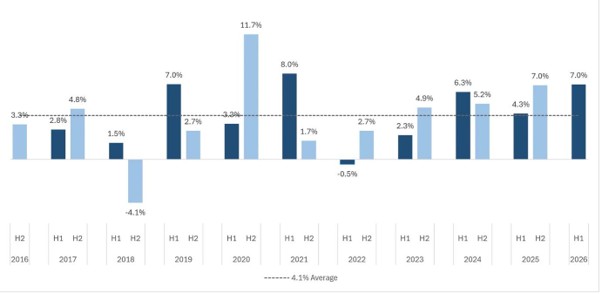
Source: Goldman Sachs5
Two caveats are in order. First, Q3 industry flow data hasn’t been published yet, so the H2 evidence so far reflects intentions, not hard numbers. Second, these figures reflect the intentions of surveyed allocators rather than total industry-wide net flows.
Nevertheless, the direction is clear: hedge funds are increasingly being considered strategic portfolio components rather than tactical instruments reserved for periods of market stress.
The macro turn: an energy shock meets a hiking Fed
The backdrop changed sharply in September. The Fed raised rates by 25bps in a unanimous vote, its first hike since 2023, and Chair Warsh said inflation had been too high for too long. The target range is now 3.75%–4.00%, though traders put about an 81% probability on a hold at the October 28 meeting. The cause is geopolitical. Warsh acknowledged that the lack of safe passage through the Strait of Hormuz keeps oil above $100 and that rate hikes cannot fix that.6 Subsequent data show that even though Hormuz traffic has returned to 80% of pre-war levels, steep increases in supply-chain costs, such as container rates and insurance, continue to keep oil above $100.7
The Fed isn’t alone. The ECB and Bank of Japan also raised rates in September, and the BIS ranks this energy shock among the most significant since the 1990s. Japan’s policy rate is now at its highest since 1995, and three of the Bank of England’s nine policymakers voted for a hike. The ECB’s deposit rate is now 2.5% following its second hike in three months.
Where the money is going
- Equity long/short: monetizing dispersion
Fundamental equity long/short is a leading destination for new hedge fund allocations. BNP Paribas found that 61% of surveyed allocators planned to allocate to the strategy.
The appeal lies in the ability to combine exposure to attractive businesses with short positions in companies facing deteriorating fundamentals, excessive valuations or structural disruption. AI-related investment provides a prominent example: semiconductor manufacturers, infrastructure providers and software businesses may experience very different earnings trajectories despite operating within the same broad technology theme.
For allocators, the key distinction will be between managers with disciplined risk controls and adaptable positioning, and those who generate alpha through market-directional bets. Stock selection is key.
- Quantitative macro and managed futures: diversification with a purpose
Systematic macro and trend-following strategies are also attracting interest as investors reassess the reliability of conventional diversification.
When inflation shocks, geopolitical developments and central bank decisions affect stocks and bonds simultaneously, managed futures can take long or short positions across liquid futures markets, while quantitative macro strategies use systematic signals to identify opportunities across rates, currencies, equities and commodities.
- Multi-strategy platforms: operational scale and risk management
The appeal of multi-strategy platforms lies in their ability to allocate capital dynamically and to combine multiple trading teams, relationships and a systematic approach to risk management. However, scale is not a guarantee of superior performance, so investors may distinguish between established platforms and specialist managers offering less crowded opportunities or more differentiated sources of alpha.
- Relative value and market neutral: reducing directional dependence
Market-neutral equity, convertible arbitrage and other relative-value strategies appeal to allocators seeking returns driven more by pricing relationships than by broad market appreciation.
While the above strategies may benefit from greater dispersion and market volatility, funding costs, leverage, liquidity and sudden correlation changes can create losses. Manager selection and operational due diligence remain essential.
Why the money is moving where it is
There are four primary factors behind allocators’ decisions.
Diversification is the main motive. Hikes driven by a supply shock hurt stocks and bonds together, which weakens the traditional 60/40 portfolio. Consequently, diversification becomes the key driver of growth. Continued volatility and the recent bond rout also tilt the scales in favor of greater diversification and away from concentration risk.
Dispersion favors stock pickers. Rising yields and an uneven AI rally create winners and losers, which is the environment equity long/short and market-neutral managers want. This dispersion was evident in September, when AI stocks outperformed.
Private markets are leaving a gap. A slowdown in private asset realizations, stretched equity and credit valuations, and high cross-asset volatility drove the Q1 case for hedge funds. Higher policy rates make illiquid commitments harder to justify and raise the hurdle for everything else.
Geography is rotating. As the BNP Paribas report shows, Europe and APAC lead planned increases, suggesting that allocators are hedging US-centric portfolios, with Japan’s normalization and Europe’s energy-driven repricing creating relative-value opportunities.8
Beyond hedge funds: selective diversification across alternatives
Hedge funds are attracting attention, but the broader allocation picture is more nuanced. Private equity and private credit continue to compete for institutional capital, although liquidity constraints, slower distributions and valuation uncertainty can affect the pace of new commitments.
The secondary market offers one way to manage this challenge. Setter Capital’s H1 2026 report recorded $107.74 billion in secondary-market transaction volume, up 5.4% year over year. Private equity accounted for $91.17 billion, while private credit transactions reached $5.14 billion, up 35.4%.9 These are transaction volumes, not net allocator flows, but they illustrate the continuing importance of liquidity solutions in private markets.
Gold and other commodities may also retain portfolio roles as inflation hedges or sources of diversification, although their returns remain sensitive to real interest rates, the dollar and positioning. The World Gold Council’s 2026 mid-year outlook highlights the interaction between geopolitical risk, interest-rate expectations and momentum in determining gold’s performance.10
The takeaway
H2 allocators are buying insurance rather than chasing returns. Expect the money to keep flowing to large multi-strategy platforms, macro and systematic strategies, and equity long/short, with pensions leading and private-market liquidity constraints pushing more capital toward liquid alternatives. The path depends on Hormuz. If the energy shock fades, central banks can pause, and the case shifts back toward returns. If it persists, more hikes make diversification the main reason to hold hedge funds.
Sources:
1. https://hedgeweek.com/news/hedge-fund-assets-surge-by-record-409bn-to-5-6tn-in-q2
2. https://thefullfx.com/hedge-fund-assets-continue-surge/
3. https://globalmarkets.cib.bnpparibas/2026-hedge-fund-allocation-survey/
5. Ibid.
8. https://globalmarkets.cib.bnpparibas/2026-hedge-fund-allocation-survey/
9. https://settervolumereport.com/edition/h1-2026
10. https://www.gold.org/goldhub/research/gold-mid-year-outlook-2026