

News Digest: Music Royalties Move From Niche to Institutional Asset Class, Says Neuberger Berman
November 11, 2026
Music royalty finance is maturing into an institutional private credit segment, according to an August 2026 analysis by Neuberger Berman’s Louay Mikdashi and Jonathan Shahrabani. They argue that early capital providers still enjoy an edge that will erode as the sector develops.
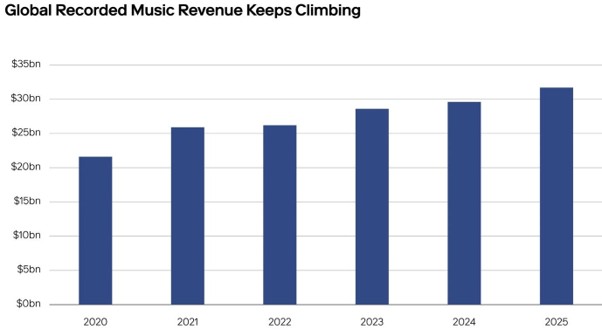
Mikdashi and Shahrabani report that global recorded music revenue has risen for eleven straight years, passing $30 billion for the first time in 2025, according to IFPI data. Growth has slowed from its post-2020 pace as subscriber additions fade in mature markets. It remains positive, supported by emerging-market adoption and periodic price increases.
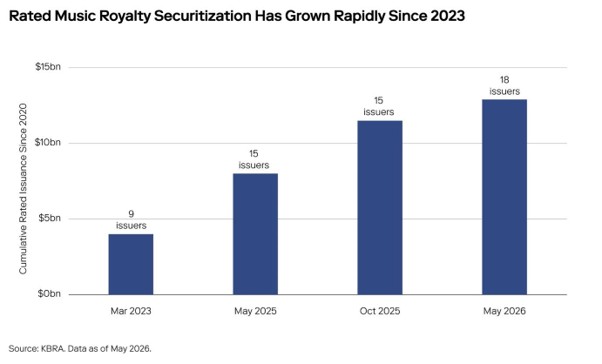
Their analysis presents two developments as the clearest evidence of institutionalization. Banks now provide senior secured loans against catalogs, and sizeable facilities have become routine. A rated securitization market has also emerged, with KBRA data showing rapid growth in rated issuance and issuer numbers since 2023. Insurers and other institutions are buying these bonds.
Catalog multiples have been broadly stable in recent years but vary widely. Citrin Cooperman data shows low-teens multiples for recent-vintage masters and mid- to high-teens for publishing and older masters. Competition is fiercest for marquee catalogs, where generalist capital concentrates. Several hundred catalogs changed hands in 2025, averaging about $23 million each, with activity centered on pop, hip-hop, and rock.
The authors favor overlooked niches, including country, Christian, soundtrack, and TV/film royalties, as well as smaller catalogs that can be aggregated. Luminate data shows Christian/Gospel was the fastest-growing US streaming genre in 2025. The long-dated cash flows are sensitive to discount rates. Other concerns include dependence on a few streaming platforms, uncertainty around younger catalogs, possible dilution of the streaming pool from AI-generated music, and limited liquidity. They see music royalties as a complement to corporate private credit, not a substitute, with return drivers distinct from corporate spread risk
End Notes