

The New Hedge Fund Playbook: Why Portfolio Construction Matters More Than Picking Winners
November 19, 2026
The last few years, and especially 2026, have seen a massive upsurge in the FUD (Fear, Uncertainty, Doubt) factor. For instance, in 2026, we had tariff uncertainty punctuated by wildly swinging US policies. Then came the Middle East conflict, which quickly escalated from a three-party conflict to engulf the rest of the region. It is not as if the conflict followed a linear route, but a serpentine one, with periods of cessation in the overall climate of attrition. That gave rise to doubt. Allocators saw opportunities coming as fast as they evaporated, and the only constant was volatility. Due diligence windows were very short as fund strategies had to adjust to moving targets (no pun intended).
The Shift from Returns to Role
The data shows the change clearly. In the Hedgeweek-AIMA H1 2026 Allocator Survey, the share of allocators citing uncorrelated returns as a rationale jumped from 49% to 68% in six months.1 AIMA’s research head said allocators value hedge funds for diversification, low correlation, and downside protection rather than outright return maximization.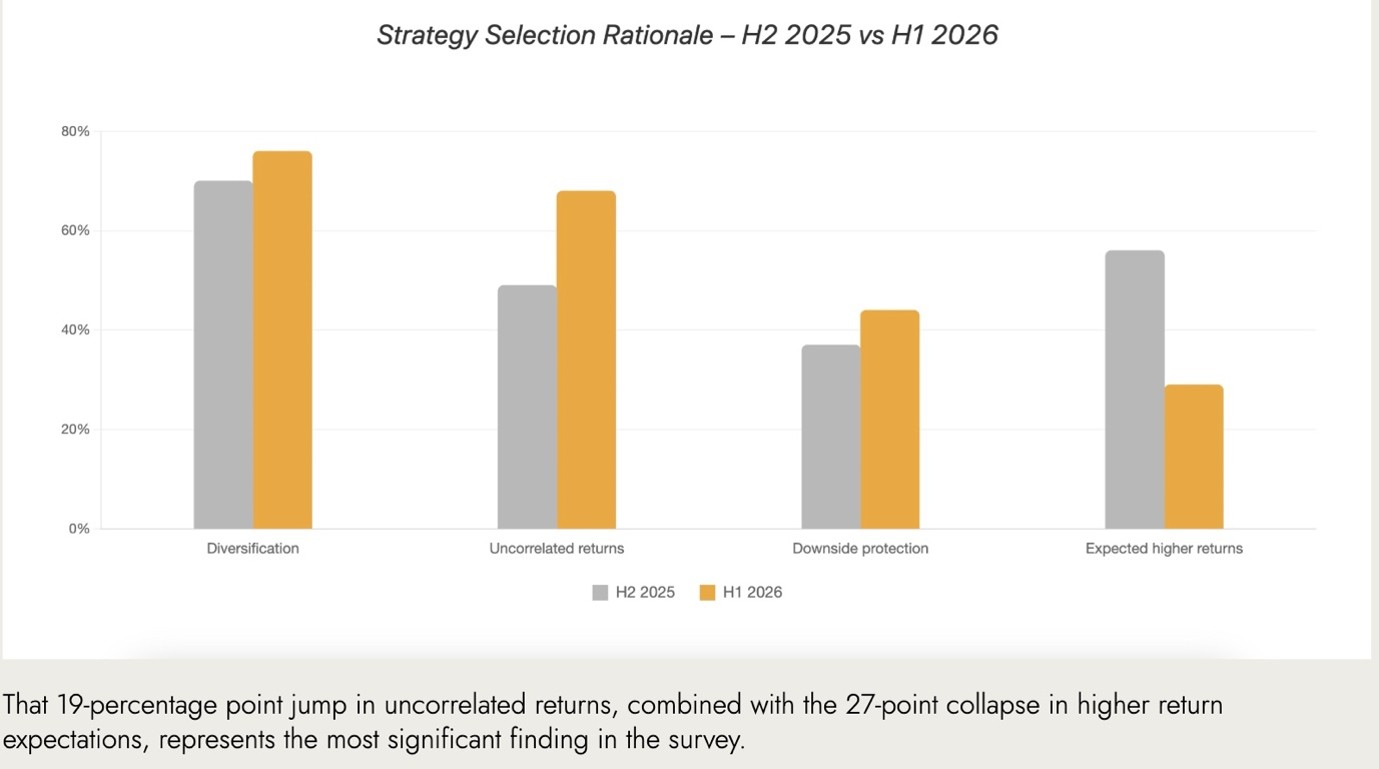
Source: Hedgeweek-AIMA H1 2026 Allocator Survey2
Other reports echo the same theme. A Schroders report found that 84% of institutional investors rank diversification as a key objective, with 83% prioritizing downside protection and 85% expecting more volatility over the next 12 to 18 months.3 Barclays’ H2 2026 survey of 340 investors found that 43% expect to be net allocators to hedge funds, with demand tilting toward low-beta strategies.4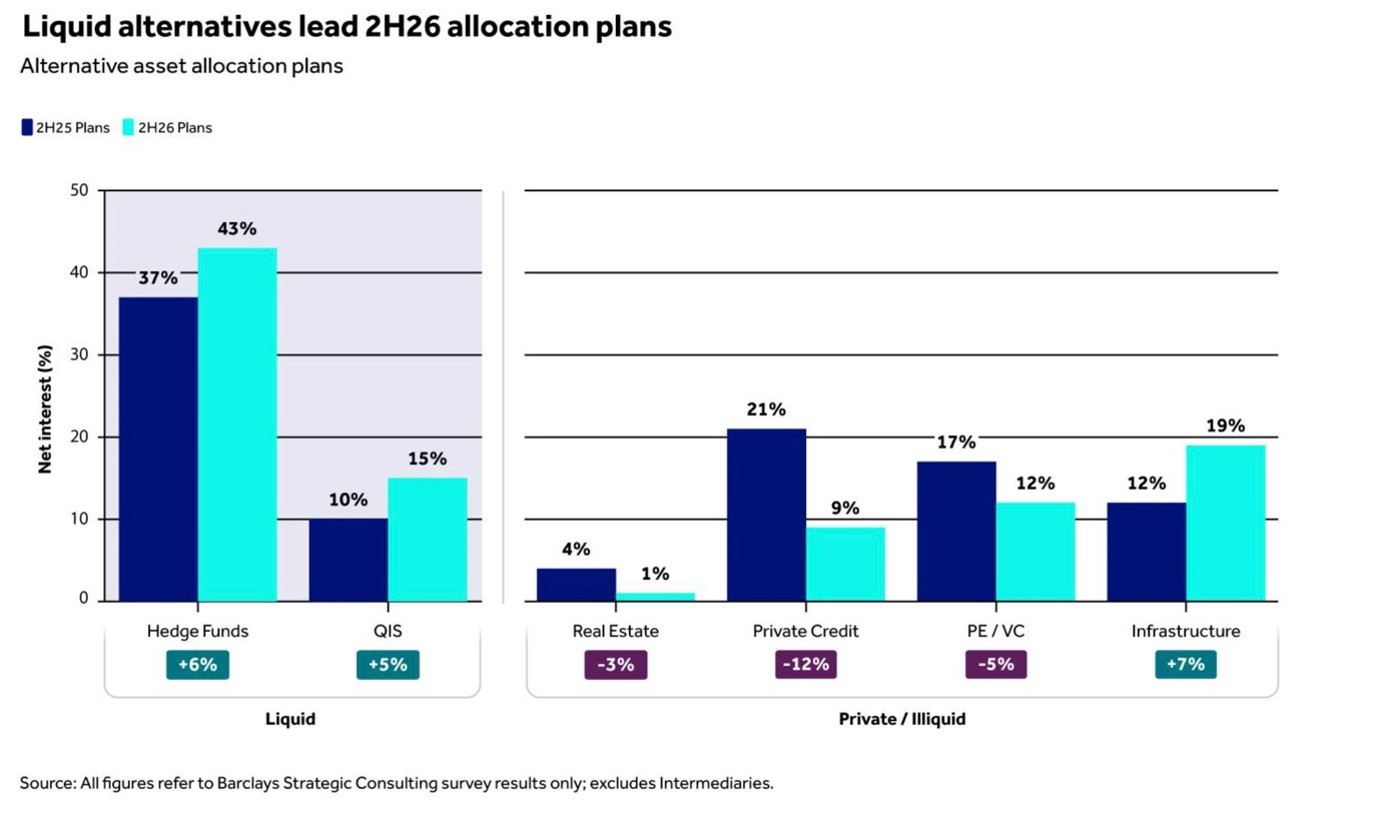
Source: Barclays Investment Bank | H2 2026 Hedge Fund Outlook5
The traditional hedge in portfolios has also weakened. Neuberger Berman notes that the stock-bond correlation is no longer reliably negative, which weakens the diversification that the 60/40 portfolio once provided. That pushes allocators to look for it elsewhere.6
Marginal Contribution Beats Standalone Sharpe
A fund with a higher Sharpe ratio that moves with equities may add less than a fund with a lower Sharpe that holds up during selloffs. The question is how the fund changes the portfolio’s overall risk and drawdown profile.
Neuberger Berman argues that allocators should size positions by each strategy’s absolute and marginal contribution to risk within the hedge fund sleeve.7 It also cautions that correlations are not fixed. In broad equity drawdowns, long/short strategies tend to converge toward equities, and in trending markets, global macro tends to converge toward managed futures. So grouping strategies by the function they serve is more reliable than relying on their labels.
Group Hedge Fund Strategies by Risk-Management Function For Optimal Diversification
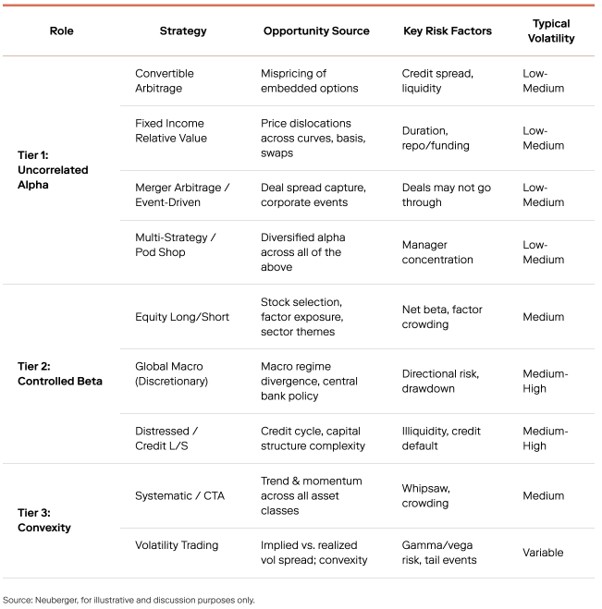
Source: Neuberger Berman8
Five Strategies, Five Jobs
- Market-neutral: This is the stabilizer. LPL Financial’s 2025 review says equity market neutral offers low correlation to equity and bond markets and works as a risk dampener, though its upside is limited in strongly trending markets.9 The HFRX Equity Market Neutral Index rose 6.1% that year.10 Implementation matters, since model drift and crowding are real risks.
- Long/short equity: This is the return engine with a hedge attached, but it carries beta. The same review shows the HFRX Hedge Equity Index up 9.9% in 2025, helped by a risk-on rally.11 The flip side appeared in March 2026, when UBS reported that equity long/short struggled and the month could rank among the worst in the strategy’s history, with the HFRI Equity Hedge Index down 4.33%.12
- Global macro: Macro is a bet on regime divergence, so its diversification varies by manager. In 2025, discretionary managers outperformed their systematic peers.13 Neuberger Berman rates its directional risk and drawdown potential as medium-high, so it needs careful sizing.
- Managed futures: Trend-following offers crisis-style convexity but is lumpy. LPL called early 2025 one of the most challenging periods in recent history for the strategy, as broken trends and whipsaws hurt results, before stabilizing late in the year.14 UBS noted that commodity trading and quant equity provided meaningful diversification during the March 2026 equity and rate stress.15 Allocators should expect long stretches of discomfort in exchange for protection when it matters.
- Multi-strategy: This approach packages diversification in a single fund. Neuberger Berman classifies multi-strategy platforms as low-to-medium volatility, but flags manager concentration as the key risk.16 Bank of America’s survey found allocators backing fewer managers with larger commitments to high-conviction multi-manager firms.17 That cuts operational complexity but increases dependence on a few platforms, and it is a portfolio construction choice in its own right.
What Allocators Now Test
- Conditional correlation: Look for correlation in the worst equity months. Average correlation only flatters a fund.
- Drawdown shape: Depth matters, but so do recovery time and whether losses coincide with the rest of the portfolio.
- Return source overlap: Two funds from different categories can hold the same crowded trade or factor. For instance, an investor buying into a US Growth Fund vs. a Global Equity Fund thinks they are diversifying globally across regions and strategies. In reality, if US tech valuations drop or interest rates spike, both funds will fall in lockstep due to their hidden overlap. Both funds end up heavily concentrated in the exact same US mega-cap momentum and AI growth factor.
- Role clarity: Each manager should have a defined job, such as stabilizer, convexity, or return driver, and be judged against it.
- Sizing discipline: A good diversifier at 2% of the portfolio does little. A volatile one at 15% can dominate risk.
Takeaways for Managers and Allocators
For managers, selling a headline return is increasingly a weak pitch. Barclays found investors say they allocate to only about 5% of the managers they meet, so clarity about your role counts for more.18 Be explicit about correlation, drawdown behavior, and where you will not help.
A fund that merely beats a benchmark may add little, while a modest, reliably uncorrelated return stream can improve the whole portfolio. The bottom line – FUD will persist and is an imponderable. Allocators’ due diligence during hedge fund selection is no longer about historical returns, but is more about portfolio construction, stress testing, and sizing each position for its contribution to risk.
Sources:
2. Ibid.
4. https://www.ib.barclays/our-insights/3-point-perspective/2H-2026-hedge-fund-outlook.html
5. Ibid.
7. Ibid.
8. Ibid.
10. Ibid.
11. Ibid.
14. Ibid.
17. https://www.hedgeweek.com/?p=99341
18. https://profundcom.net/?p=21178