

From Bitcoin to Tokenized Treasuries: The Institutionalization of Digital Assets
November 20, 2026
Digital assets are moving beyond cryptocurrency speculation into the architecture of institutional finance. Tokenized government securities, money-market funds, private credit, and other real-world assets are creating new opportunities for asset managers, banks, and institutional investors.
For much of the past decade, institutional engagement with digital assets was largely synonymous with Bitcoin. The debate centered on cryptocurrency as an alternative store of value, portfolio diversifier, or speculative investment. That conversation is now evolving. Increasingly, the institutional opportunity lies not simply in owning digital assets, but in using blockchain infrastructure to transform how traditional financial assets are issued, held, transferred, and managed.
The distinction is important. Institutional investors are not necessarily replacing traditional portfolios with cryptocurrencies. They are beginning to explore how the underlying technology can make conventional investments more accessible, programmable and operationally efficient.
The shift from crypto exposure to financial infrastructure
Bitcoin is a scarce, non-yielding bearer asset. Tokenized Treasuries are the opposite: a familiar, yield-bearing instrument whose ownership record and settlement happen on a blockchain. For a treasurer or fund manager, the appeal is practical. The emergence of tokenized US Treasuries, money-market funds, private credit and other real-world assets (RWAs) represents a significant development in this transition. Instead of creating an entirely new asset class, tokenization is bringing familiar financial instruments onto blockchain-based infrastructure.
The institutionalization of digital assets is increasingly visible in the market’s composition. Bitcoin remains an important gateway, but the growth of tokenized financial instruments suggests a broader transformation.
According to the International Monetary Fund’s October 2026 Global Financial Stability Report, tokenized fixed-income assets, including corporate credit, asset-backed credit and money-market fund holdings, account for approximately $48 billion. This includes around $30.4 billion in tokenized credit and $17.5 billion in tokenized money-market funds. Tokenized equities, by comparison, remain a considerably smaller segment.1
While estimates of the current market size may vary, they illustrate where institutional demand is developing instruments with established cash flows, recognizable underlying assets, and familiar investment characteristics. Equally important is the institutional embrace of RWAs. Again, while estimates vary, by 2030, the RWA market is expected to be between $9 billion (Investas) and $16T (Boston Consulting Group).2,3
A particularly interesting development is the growing interest in tokenized money-market funds and government securities. These products offer exposure to short-duration, relatively low-risk instruments while introducing blockchain-based settlement and ownership records.
The January 2026 Coinbase and EY-Parthenon institutional investor survey reinforces this trend. Among respondents interested in tokenized assets, 50% identified tokenized money-market funds as an investment area of interest, 49% selected corporate bonds and 44% government bonds.4
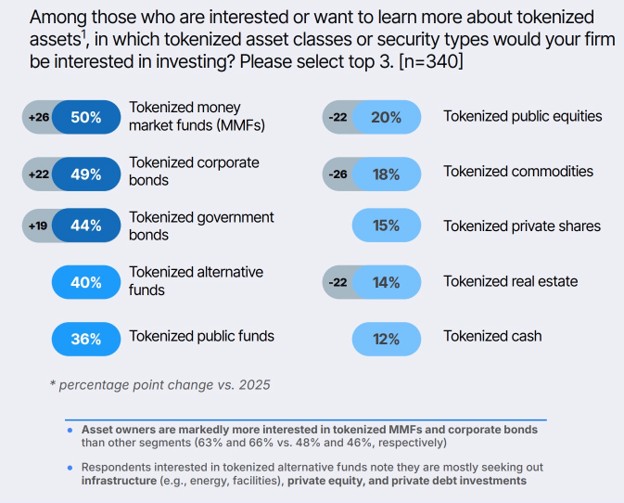
Source: 2026 Institutional Investor Survey, Coinbase and EY-Parthenon5
This is a meaningful indication that institutional tokenization is moving towards the core of conventional portfolio management rather than remaining confined to crypto-native investment strategies.
Tokenized treasuries: The institutional entry point
Tokenized government securities have emerged as one of the most compelling applications of the technology.
The attraction is straightforward. Investors receive exposure to underlying financial instruments through digitally represented fund interests, with the potential benefits of faster settlement, more transparent ownership records, and easier integration with digital-asset platforms.
Tokenized Treasury products could also become useful collateral in institutional trading and lending arrangements. Rather than moving assets through multiple intermediaries and settlement systems, investors can potentially transfer eligible tokenized interests across compatible platforms.
One CryptoSlate analysis estimates that tokenized US Treasuries grew from about $3.95 billion in January 2025 to $8.86 billion by January 2026.6 By mid-September 2026, rwa.xyz data summarized by Eco showed $15.65 billion across 101 tokenized Treasury and money-market products.7
The Bank for International Settlements has identified tokenized government bonds as an important component of the next-generation financial system. Its proposed vision of a unified ledger brings together central-bank reserves, commercial-bank money and government securities, allowing financial transactions to be executed more efficiently.8
This is not a simple innovation. It is a potential redesign of the plumbing that underpins capital markets.
Beyond treasuries: Private credit and alternative assets enter the equation
Treasuries were the entry point, but they are no longer the whole story. Token Terminal data reported by Crypto Briefing suggests US T-bills now make up less than a third of the on-chain RWA market as credit funds and yield strategies gain ground.9 According to rwa.xyz estimates, other categories include:
- Private credit: about $8 billion in distributed value.
- Commodities: about $4.85 billion, dominated by gold tokens such as PAXG and XAUT.
- Tokenized stocks: about $2.9 billion, the fastest-moving category over the 30 days to mid-September.10
Beyond government securities, tokenization is opening new possibilities in private markets, particularly private credit, structured debt, real estate and infrastructure.
Private credit is an interesting use case because it has traditionally involved complex documentation, restricted investor access, lengthy settlement processes and limited secondary-market liquidity. Tokenization can potentially simplify investor onboarding, automate interest distributions, maintain ownership records and facilitate transfers between eligible investors.
For fund managers, this could mean more efficient administration and distribution. For investors, it could create access to investment opportunities through fractional interests and digital investment vehicles, subject to applicable eligibility and regulatory requirements.
However, tokenization does not change the underlying credit risk. A loan that is poorly underwritten does not become safer because its ownership is recorded on a blockchain. Nor does converting a private loan into a digital token automatically create a liquid secondary market.
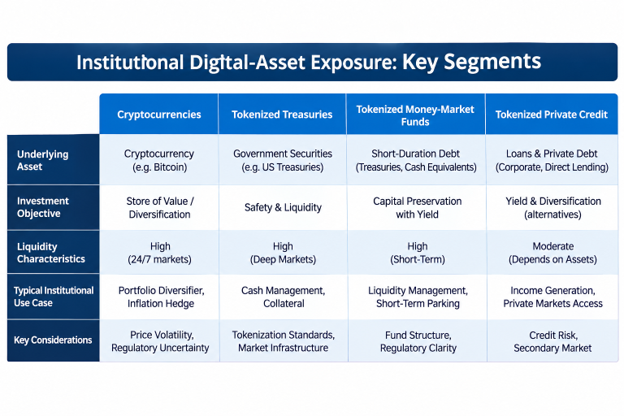
Source: Rostrum Grand Research
Also of significance is the growing importance of tokenized credit, particularly asset-backed credit, within the broader digital asset ecosystem. This matters because it suggests the next phase of adoption could extend well beyond short-duration government securities into more sophisticated institutional investment strategies.
Custody, regulation and the institutional trust framework
For institutional investors, the central question is no longer simply whether blockchain technology works. It is whether the investment structure offers the same legal certainty, operational safeguards and governance standards expected from conventional financial instruments. There is also a distinction between issuer-sponsored tokenized securities and third-party tokens that merely provide exposure to an underlying asset. The legal rights attached to these structures can differ considerably.
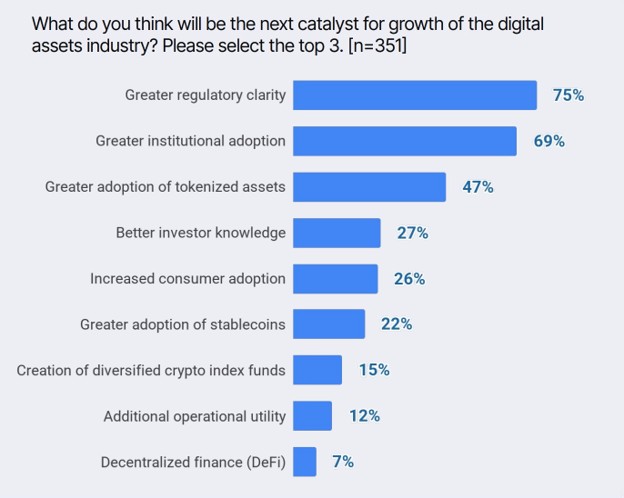
According to the EY-Parthenon-Coinbase survey, regulatory clarity and greater institutional adoption are seen as key growth catalysts.11
Custody is particularly important. Institutions need clarity on who holds the underlying assets, who controls the digital keys, how ownership is recorded, and what happens if an issuer, custodian, or technology provider becomes insolvent. At a broad level, large firms ($500B-$ 1T AUM) will prefer the multi-custodian route for risk mitigation. On the other hand, a single custodian is predicated on integration cost concerns.
The US Securities and Exchange Commission addressed this distinction in its January 2026 statement on tokenized securities. It clarified that securities do not escape existing securities-law requirements simply because they are represented on a blockchain. Registration, disclosure, and investor-protection obligations continue to apply, while third-party tokenization structures can introduce additional counterparty and ownership risks.12
This is an important step towards institutional acceptance. Rather than treating tokenization as a regulatory exception, the framework increasingly seeks to integrate it into existing securities-market rules.
Liquidity: The promise and the reality
One of tokenization’s strongest propositions is the possibility of faster settlement and improved liquidity. However, 24/7 transferability should not be confused with 24/7 liquidity. A token representing a private credit fund or a money-market investment remains subject to its underlying redemption terms, investor restrictions and market depth. Liquidity ultimately depends on buyers, sellers, market-making arrangements and the legal ability to transfer the asset.
Traditional financial markets operate through multiple intermediaries, settlement windows and jurisdiction-specific infrastructure. Blockchain networks can potentially enable near-real-time transfers, round-the-clock transaction processing and programmable settlement.
For institutions managing collateral, cash and short-term liquidity, these capabilities could be particularly valuable. Tokenized Treasury holdings, for instance, could eventually be transferred and used as collateral across compatible institutional platforms.
The emergence of institutional investment structures
The next stage of adoption is likely to be driven by investment structures that combine traditional portfolio management with digital-asset infrastructure.
Several models are emerging:
- Tokenized money-market funds: Digital fund interests backed by short-duration government securities and other eligible money-market instruments.
- Digital securities funds: Regulated investment vehicles offering exposure to tokenized bonds, equities and other securities.
- Tokenized private-market funds: Digital representations of interests in private equity, private credit, infrastructure and real estate funds.
- Institutional digital-asset platforms: Custody, trading, collateral management and settlement infrastructure connecting traditional financial institutions with blockchain networks.
For asset managers, these structures could improve distribution, reduce administrative costs and enable more efficient portfolio operations. For family offices and wealth managers, they could eventually provide access to a broader universe of investments through familiar fund and managed-account structures.
From an alternative asset to an alternative infrastructure
The institutionalization of digital assets represents a more fundamental change than the growing acceptance of Bitcoin by investment portfolios.
The emerging opportunity is integrating blockchain technology into conventional capital markets. Tokenized Treasuries, money-market funds and private credit are potentially early examples of how financial products could be issued, distributed, settled and administered differently.
For institutional investors, the attraction is not necessarily higher returns or exposure to cryptocurrency price movements. It is the possibility of improving operational efficiency, expanding investment access, deploying collateral more effectively and creating new portfolio-management capabilities.
There are still important obstacles: fragmented regulation, interoperability between blockchain networks, cybersecurity, custody arrangements, redemption constraints and the development of genuinely liquid secondary markets. These will determine how quickly tokenization moves from pilot projects into mainstream institutional portfolios.
But the direction is becoming clearer. The next generation of digital assets may be less about speculative cryptocurrencies and more about familiar financial instruments operating on unfamiliar infrastructure.
Sources:
1. https://www.imf.org/en/publications/gfsr
2. https://investax.io/blog/q3-2025-real-world-asset-tokenization-market-report
5. Ibid.
8. https://www.bis.org/publications/aer-2025/next-generation-monetary-financial-system
9. https://cryptobriefing.com/tokenized-rwa-market-hits-46-billion/