

Climate Adaptation as an Investment Theme in Real Estate
June 11, 2026
How Flood Resilience, Water Security, Heat Management, and Climate-Proof Infrastructure Are Driving Future Returns
For decades, real estate investment turned on a familiar axis: location, yield, tenant quality, and interest rates. Today, climate resilience is the fifth variable commanding attention on every serious investment committee. With the continuing narrative on climate change gaining decibels across the world and evidence of physical hazards intensifying, and regulatory frameworks catching up, infrastructure’s ability to withstand floods, manage heat, and secure water is no longer an ESG sidebar. It is becoming a direct driver of valuation, financing, and exit value.
From Mitigation to Adaptation: A Necessary Pivot
The industry’s climate focus has historically been on cutting emissions. That framing is broadening. According to Morgan Stanley’s Calvert investment research, worsening physical conditions are forcing a rebalancing toward adaptation — yet in 2026, global clean energy investment is set to surpass $2 trillion while climate adaptation spending remains below $100 billion annually.1 That gap is both a market failure and an investment signal. Calvert’s conclusion: adaptation should be viewed not as a cost center but as an enabler of asset value preservation.
The scale of exposure makes this urgent. The OECD’s Future-Proofing Real Estate Investment report puts climate-related disaster costs at up to $430 billion per year globally — roughly 0.5% of global GDP — with total damage in the first half of 2025 alone reaching $131 billion.2 Crucially, these risks are structural, not cyclical. In the OECD’s 2025 survey, 37% expect to carry climate-related risk for the full life of their assets, and only 2% believe those risks will dissipate within a year. Investors are waking up to the fact that they cannot wait out this repricing.
Flood Resilience: Where Capital Is Moving
Flooding is the most immediate and measurable risk facing real estate portfolios. CoreLogic data cited by Alliance CGC puts the number of U.S. properties facing substantial flood risk at over 14.6 million — a figure now treated with the same seriousness as credit quality in acquisition underwriting.3
Urban-scale responses are accelerating. At the bond market level, Texas’s Resilience Infrastructure Bonds now yield 10–15% above inflation, and the state’s Flood Infrastructure Fund is targeting $5 billion by 2030, up from an initial $793 million, according to AInvest.4
According to Global Finance magazine, which cited a 2025 report by Singapore’s sovereign wealth fund, GIC, and the consultancy Bain, climate adaptation is moving from a defensive necessity to a hyper-lucrative asset class.5 While the total global investment opportunity is projected to scale from $2 trillion today to $9 trillion by 2050, the direct financial returns are pacing right alongside it. Annual revenues harvested from adaptation solutions—including flood infrastructure, weather intelligence, and water conservation tech—are on track to quadruple, explosive growth that will see today’s $1 trillion in yearly revenue balloon into a massive $4 trillion annual payout by 2050.
Sophisticated acquirers are no longer relying on historical flood maps. Real estate developers are turning to advanced climate modeling tools that combine digital twins with satellite remote sensing to derive asset-level flood probability across different emissions pathways and time horizons. Due diligence has been fundamentally rewritten.
Water Security: The Silent Portfolio Risk
Where flooding is acute, water scarcity is chronic and increasingly material. A JLL 2024 bank survey, cited by Munich Re, found that the weight of climate risks, which include water stress, in lending decisions is expected to double within five years, with flooding, storms, and heat named as the top concerns.6
For logistics facilities, data centers, and multifamily assets in arid or fast-growing markets, water availability is fast becoming a viability question, not just an efficiency one. Properties with on-site greywater recycling, rainwater harvesting, and low-flow systems are commanding a growing premium from institutional allocators who prize long-duration cash-flow stability. Cities with robust water security roadmaps, such as Singapore, Amsterdam, and select U.S. Mountain West metros, are pulling ahead as preferred destinations for patient capital. Water security, once a background factor in ESG reporting, is entering the front pages of investment memoranda.
Heat Management: A New Line in the Underwriting Model
Extreme heat is perhaps the most underestimated valuation risk in commercial real estate. Buildings without passive cooling, reflective roofing, or efficient HVAC face mounting energy costs and serious habitability concerns in both commercial and residential structures.
Source: McKinsey & Company7
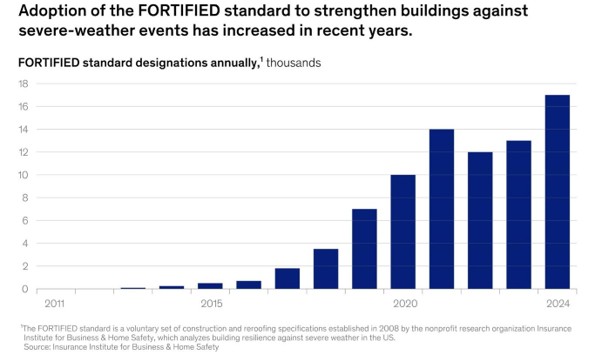
McKinsey’s September 2025 analysis of climate resilience technology highlights the pace of market response: the number of buildings adopting FORTIFIED resilience standards, which cover storm, heat, and flood resilience, doubled between 2019 and 2024, with a 30% jump in 2023–2024 alone and new application submissions growing a record 160% in that period. Investors entering that market now price heat performance data alongside flood zone classifications. Green roofs, smart glass, microclimate landscaping, decentralized energy systems, etc., are no longer optional upgrades but increasingly the difference between a competitive and an obsolete asset.
The Road Ahead
The OECD’s Future-Proofing Real Estate Investment report provides recommendations to guide investors seeking to leverage the current situation to generate Alpha.8 Broadly speaking, OECD recommendations can be paraphrased as follows:
- Avoid high-risk areas and integrate localized, open data: Urban development is expanding rapidly into floodplains and heat-stressed zones, exposing vulnerable, low-income communities to severe financial shocks. To halt this trend, governments must embed forward-looking hazard maps and climate projections directly into zoning laws, building codes, and permitting processes.Because 58% of investors currently lack granular data, public authorities should build open-access national data platforms that combine property-level risk indicators with existing financial and insurance networks. Mandating systematic climate disclosures at key transaction points—such as property sales, leases, or mortgage issuances—will erase market blind spots, establish shared data structures, and align private capital incentives with long-term regional safety.
- Drive adaptation and decarbonization via financial instruments: Physical climate damage rapidly translates into asset devaluations, loan defaults, and soaring insurance premiums that disproportionately penalize renters and low-income homeowners. To protect property values and secure a just transition, policy frameworks must combine strict regulatory mandates with robust financial carrots. Tools like minimum energy performance standards set the operational baseline, while public subsidies, tax deductions, and preferential lending offset initial transition costs.For small property owners, green mortgages and pooled retrofit financing can lower the cost of capital for vital resiliency upgrades. For institutional developers, instruments such as resilience bonds, credit-enhanced structures, and blended finance will unlock massive private investment in community-scale infrastructure, including dykes and nature-based solutions.
- Standardize measurement and reporting for global finance: Because real estate capital flows globally, the current fragmentation of climate models, risk assumptions, and regional building certifications creates severe inefficiencies for cross-border investors. Establishing international coordination to harmonize disclosure frameworks, terminology, and performance metrics is essential to eliminate market uncertainty and allow regulators to accurately assess systemic risks.
Governments and financial supervisors should actively utilize international platforms to exchange knowledge on zoning practices, certification schemes, and transition pathways. By anchoring a coherent, global framework for data sharing and risk-pooling, the international community can stabilize real estate finance, facilitate cross-border investment flows, and confidently direct capital toward climate-proof assets.
Adaptation Is Alpha
Climate adaptation isn’t a cost but a competitive moat. Assets built for tomorrow’s climate projections will operate more cheaply, clear regulatory hurdles easily, and attract premium capital, leaving unadapted properties stranded to choke on rising operational costs and compounding risk. Climate adaptation in real estate has moved from risk management to return generation. Assets with robust flood defenses, heat-resilient design, water security infrastructure, and climate-proof systems are outperforming peers on rent growth, occupancy, and insurance cost management, all the while offering structural protection against the most significant repricing event facing real assets over the next two decades.
The investors repricing this today — building adaptation into acquisition screens, development briefs, and portfolio construction — will not simply avoid the losses. They will compound the gains.
Sources:
3. https://www.alliancecgc.com/lifestyle/how-climate-change-reshaping-real-estate-investment
5. https://gfmag.com/insurance/from-reactive-insurance-to-proactive-investment/