

Data Center and Digital Infrastructure REITs: The New Core Real Estate Allocation
August 14, 2026
For decades, the definition of “core” real estate was limited to office buildings, shopping centers, multifamily housing, logistics warehouses, and high-quality industrial properties. The appeal was simple: predictable cash flows, long leases, strong tenants, and relatively durable demand.
Artificial intelligence is beginning to rewrite that definition.
The rapid expansion of generative AI, cloud computing, and digital services is transforming data centers from a specialist real estate niche into critical economic infrastructure. For institutional investors, the more important question is no longer whether data centers belong in a real estate portfolio, but whether they should increasingly be considered part of its core allocation.
From property to infrastructure
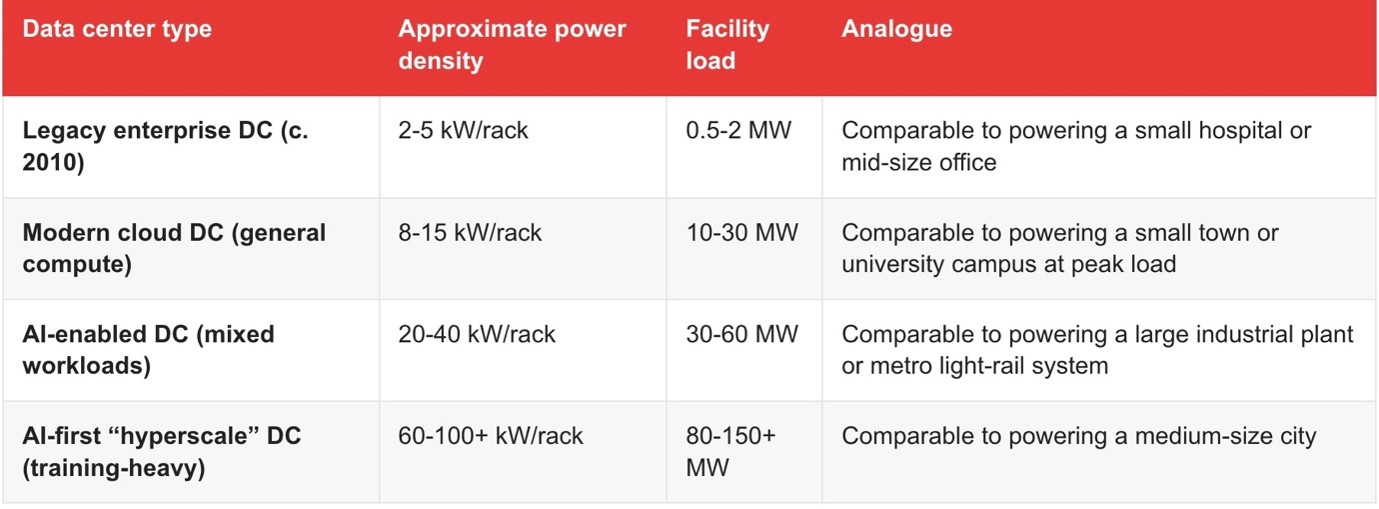
The concept of data centers is not new. Traditional applications, such as enterprise computing, web hosting, cloud, and mobile services, have been the primary applications running on centralized infrastructure, with CPU racks supporting diverse workloads and near-zero latency. On the other hand, a data center running AI workloads (whether training or inference) is likely to rely on Graphics Processing Units (GPUs), requiring a much higher degree of support systems, such as cooling and zero-power latency. As a result, AI workloads require substantially greater computing intensity than conventional enterprise applications. AI-focused data centers require substantially higher power density per server rack compared with traditional facilities. As the application stack grows within a data center, the power density is also climbing: from 2-5 kW/Rack to an estimated 60-100+ kW/rack. This creates demand for liquid cooling, higher floor loading, sophisticated electrical systems, and significantly greater power availability.
Source: Peak Technical1
From Alternative to Essential
Digital Realty Trust closed its first commingled U.S. hyperscale data center fund at $3.25 billion in equity commitments. The fund drew commitments from public pensions, sovereign wealth funds, endowments and foundations, corporate pensions, insurance companies, asset managers, and family offices, and its close was described as confirming that data centers have crossed the threshold from alternative asset to core portfolio allocation. That breadth of investor base — the same institutions that historically anchored office and industrial funds — is the tell. This isn’t speculative tech capital; it’s the conservative, liability-matching money that defines “core.”
Allocation models are adjusting accordingly. Large pension funds now separate AI compute infrastructure from the AI application layer in their asset allocation frameworks, placing data centers, chip fabrication facilities, and power generation in real-asset portfolios while software remains in alternatives. The logic is straightforward: infrastructure drives demand tied to broad economic growth rather than to the survival of any individual startup. A data center lease backed by a hyperscaler’s balance sheet behaves more like a long-duration bond with real-asset upside than a venture bet.
The Changed Math
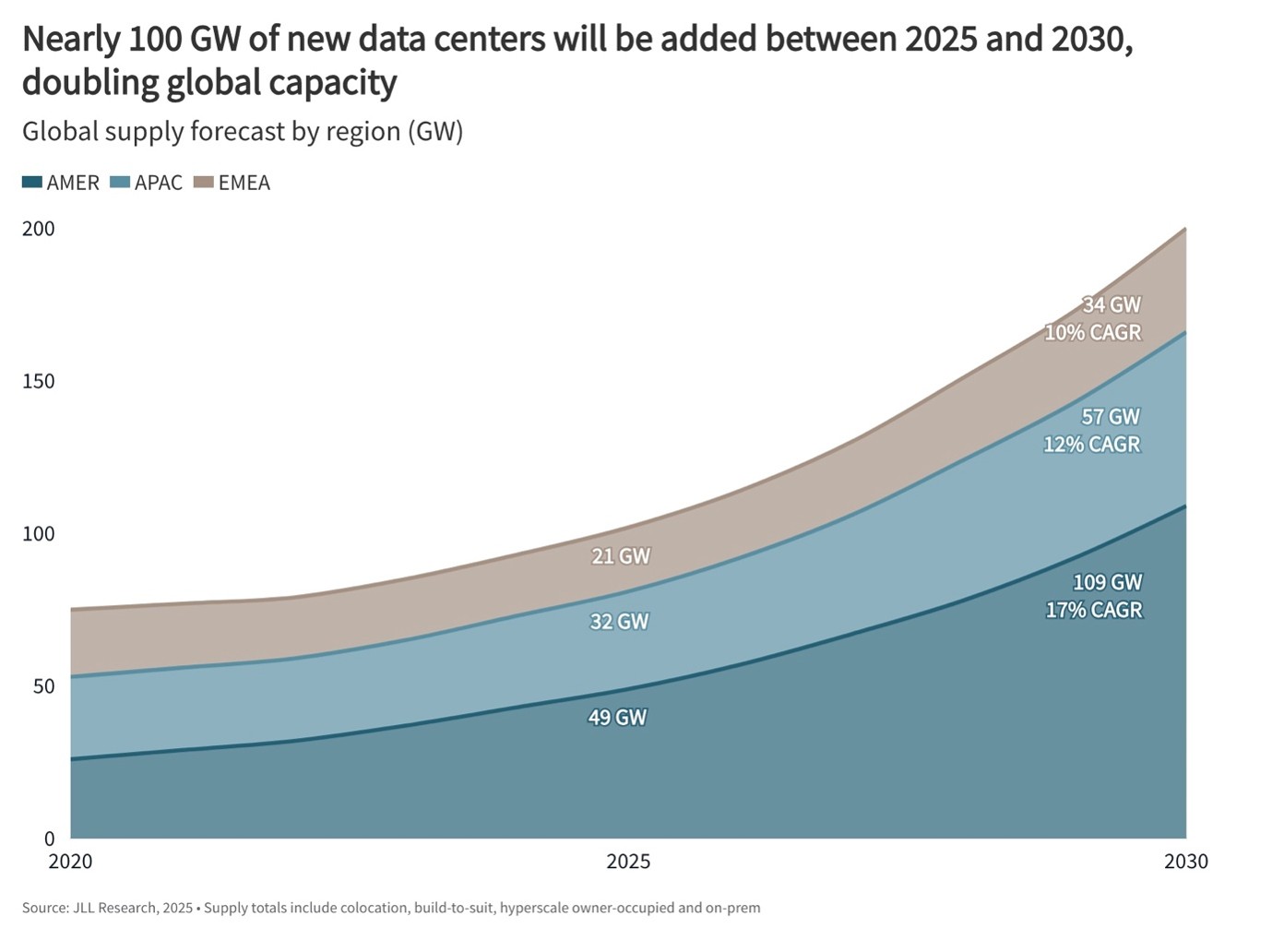
With roughly $ 700 billion in capex likely in 2026 in AI infrastructure and estimates that place roughly half the global energy forecast as being driven by the data center, the sector is entering what’s being called an infrastructure investment supercycle, requiring up to $3 trillion by 2030 with roughly 100 gigawatts of new capacity translating into an estimated $1.2 trillion in real estate asset value creation.
Source: JLL2
That capex isn’t discretionary tech spending that could evaporate in a downturn: it’s being structured as long-term leases with the world’s most creditworthy tenants. The unit economics of data center REITs in the AI era are notably more attractive than in the prior cloud-computing era: rental rates per square foot or per megawatt have risen, lease terms have lengthened, and tenant credit quality has improved as hyperscalers now represent the largest counterparties in the market.
For institutions used to underwriting office leases against uncertain post-pandemic demand, a 10-15-year lease with Microsoft or Amazon looks like a different risk category entirely.
But “core” does not mean risk-free
The investment case has important caveats.
First, data centers are extraordinarily capital intensive. Maintaining technological relevance requires continuous investment in power, cooling, and equipment.
Second, electricity is becoming a strategic constraint. AI infrastructure can require hundreds of megawatts for individual campuses, creating competition for grid capacity and increasing exposure to utility regulation and power prices.
Third, community and permitting risks are rising. Reuters reported that lenders are increasingly scrutinizing data-center projects due to opposition to electricity consumption, water use, noise, and impacts on local infrastructure.3
For global investors, this creates an interesting shift: the next generation of “prime real estate” may be located wherever large quantities of reliable electricity and high-speed connectivity can be secured. Given the degree of the shortfall, investors would also look at the speed-to-build. According to JLL, average grid connection lead times could range from 2 to 8 years, depending on municipal clearances, interconnect agreements with existing and/or new players, and transitory BYOP solutions in which the data center builds its own power generation as an interim alternative to the grid.4
Why REITs are attractive to institutional investors
Data center REITs offer institutions a liquid route into a rapidly expanding infrastructure theme without requiring direct ownership and development of highly specialized facilities.
The operational numbers are increasingly supportive. According to Nareit, data center REITs recorded average year-on-year growth in Funds From Operations (FFO) of 29.4% and Net Operating Income (NOI) of 15.8% in the first quarter of 2026. Data centers were also among the strongest-performing REIT sectors through the middle of 2026.5
For institutional portfolios, several characteristics are particularly attractive:
- Structural rather than purely cyclical demand: AI, cloud computing, digital payments, streaming, and enterprise software all require physical computing infrastructure. Demand is therefore linked to the continued digitization of the economy rather than to GDP growth alone.
- High barriers to entry: The challenge is no longer merely acquiring land. Developers need power, permits, grid connections, fiber, cooling infrastructure, and increasingly community acceptance.
- Long-duration leases: Large hyperscale customers can provide substantial visibility into contracted revenue, potentially making data center cash flows more predictable than those of many traditional property sectors.
- Scarcity value: Where power and connectivity are constrained, existing facilities can acquire an infrastructure premium because replacement supply cannot be delivered quickly.
Operational Responses by REITs
To navigate grid interconnect bottlenecks and maintain earnings growth, data center REITs are deploying distinct operational strategies:
- Behind-the-Meter (BTM) Generation: REITs are partnering directly with energy providers to deploy co-located power solutions (such as microgrids, natural gas turbines, and small modular reactors/nuclear agreements) to bypass long public grid queues.
- Joint Ventures & Capital Recycling: Given the immense capital required to build out high-density substations and liquid-cooling infrastructure, public REITs are forming multi-billion-dollar joint ventures with private equity and sovereign wealth funds to offload balance sheet leverage while keeping management fees.
- Brownfield Retrofits: Converting older, low-density cloud facilities into high-density AI-ready facilities using direct-to-chip liquid cooling allows REITs to unlock additional megawatt utilization out of existing grid allocation.

That combination increasingly resembles the characteristics traditionally associated with core real estate: predictable income, high barriers to entry, and long-term structural demand. The broader implication is significant. AI is not merely creating a new technology sector; it is changing the physical infrastructure requirements of the global economy, whereby data centers may not simply be the next major real estate sector. They may be redefining what “core real estate” means.
Sources:
1. https://peaktechnical.com/ai-data-center-grid-partner-power-engineers-2026/
2. https://www.jll.com/en-us/insights/market-outlook/data-center-outlook
4. https://www.jll.com/en-us/insights/market-outlook/data-center-outlook