

Direct Real Asset & Infrastructure Co-Investments: Family Offices Deepen Their Partnerships With Funds
July 31, 2026
For decades, exposure to energy, infrastructure, and defense-adjacent real assets meant writing a passive check into a closed-end fund and waiting out a decade-long J-curve. That posture is evolving — but not in the “cut out the middleman” direction some headlines suggest. Rather than abandoning fund structures, a growing cohort of sophisticated family offices is deepening its relationships with private equity and infrastructure managers, moving from passive limited partners into active co-investment partners who sit alongside a fund’s general partner (GP) on individual deals. Increasingly, these partnerships — sometimes joined by two or three peer family offices in a “club” alongside the sponsor — are targeting the physical assets underpinning the reshoring era: local energy generation, defense-industrial resilience, and critical infrastructure.
Co-investing isn’t a way of avoiding fund managers; it’s a way of working with them more selectively. Inconsistent deal flow, thinner internal due-diligence capacity, and the operational burden of structuring, monitoring, and reporting on illiquid holdings are the most commonly cited challenges for family offices without a large in-house team. That is precisely why co-investment and club structures alongside an experienced GP have become the dominant model: they let a family office tap a fund manager’s origination and underwriting engine, negotiate better economics on a specific deal, and still maintain a seat at the table on major decisions without needing to replicate that infrastructure themselves.
For families with the scale, patience, and risk tolerance to hold real, physical assets for a decade or more, deepening ties with specialist fund managers — rather than working around them — is proving to be the more durable path to exposure in the reshoring and energy-security megatrends reshaping the industrial economy.
Why Co-Investing Alongside Funds Is Gaining Ground
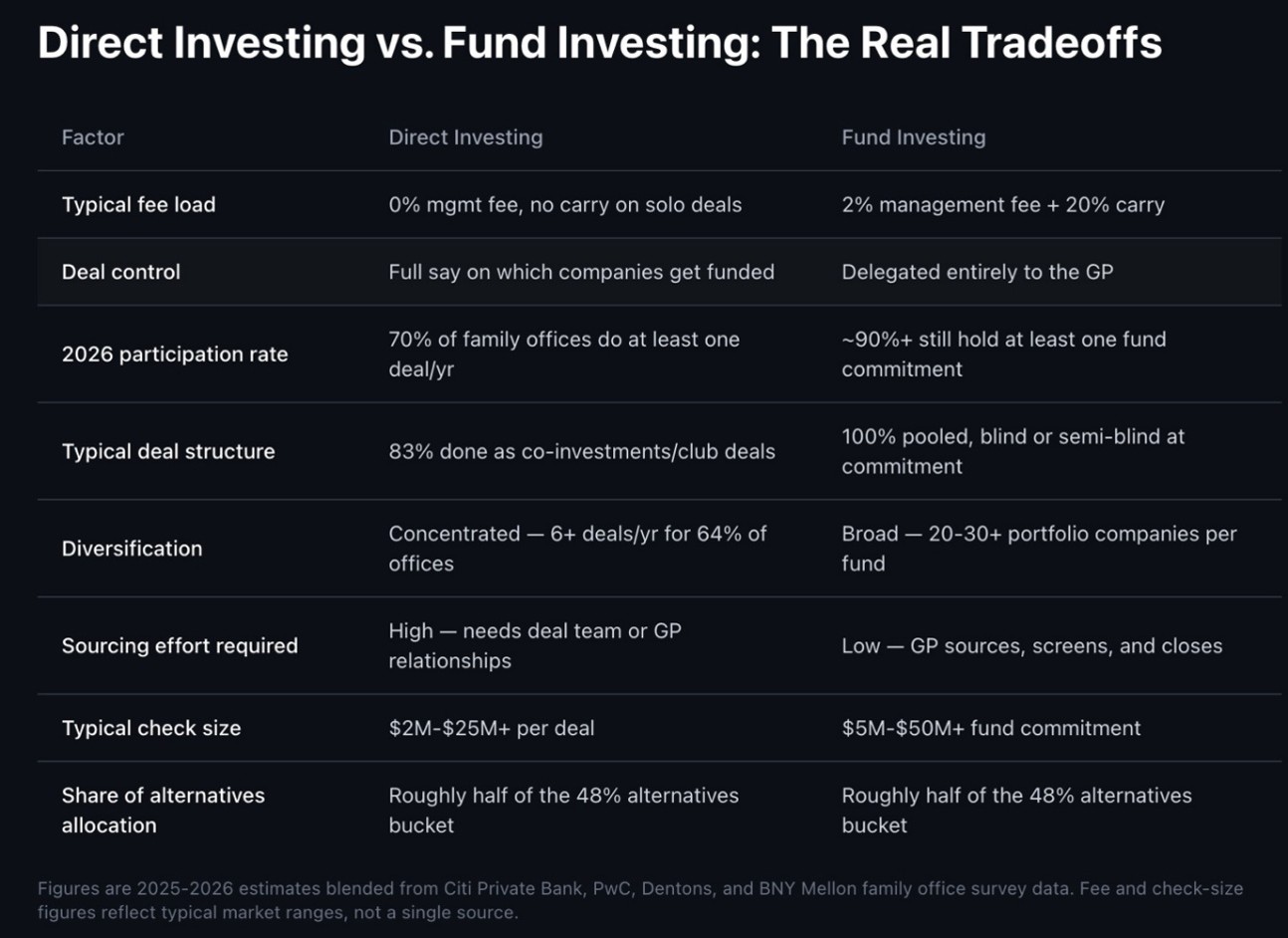
The rationale is largely economic. Standard private equity and infrastructure fund terms typically carry a 1.5–2% annual management fee plus 20% carried interest above a hurdle. Co-investment structures let a family office negotiate reduced or waived fees on a specific deal while still relying on the fund manager’s origination, underwriting, and monitoring capabilities — the best of both a direct check and institutional-grade diligence.
Family offices have grown into a substantial pool of capital available for this kind of partnership: over 8,000 offices globally now oversee roughly $5.5 trillion, a figure some projections put closer to $9 trillion by 2030. Private markets have become the single largest allocation category in the average family office portfolio at around 29%, and alternatives broadly — private equity, private debt, real estate, and infrastructure — now account for roughly 42% of family office assets globally, according to UBS’s 2026 Global Family Office Report.1
Rather than replacing fund relationships, this capital is increasingly layered on top of them. Recent survey data from Citi and PwC indicates that around 70% of family offices now make direct private investments, and roughly 83% of those deals are structured as co-investments alongside a lead fund manager or peer family offices — not as solo transactions.2,3 Separate industry estimates put the share of family office private equity activity involving direct investments or co-investments alongside fund managers at 30–50%. UBS’s tracking similarly shows that after direct allocations peaked relative to fund commitments in 2021, the two have since converged, with families now splitting new capital roughly evenly between direct/co-invest deals and fund commitments — a sign that funds remain very much part of the picture rather than being displaced.
Fund managers, in turn, are courting this capital deliberately. Guidance aimed at general partners raising new vehicles now treats family offices as a priority LP segment — among the most likely investors to take a first meeting, move quickly, and stay engaged as a fund scales — precisely because of their appetite for co-investment alongside a primary fund commitment. In real estate and infrastructure specifically, family offices are also showing up as strategic co-GP or GP-stake partners: funding a sponsor’s own GP commitment in a joint venture in exchange for a share of promote economics and approval rights, which deepens the family office/fund relationship rather than sidestepping it.
Where the Capital Is Flowing: Energy, Defense, and Reshoring Infrastructure
The sectors drawing the most co-investment interest track closely with the broader reshoring and supply-chain-resilience narrative reshaping industrial policy in the US and Europe.
- Energy infrastructure is a magnet. North America is seeing accelerating electricity demand driven by data centers, reshored manufacturing, electrification, and EV adoption — and utilities can’t build transmission, generation, and grid-modernization capacity fast enough. That scarcity is pushing returns higher across the electricity value chain, from transmission grids to flexible generation to renewable platforms, making these projects attractive targets for family offices to fund alongside specialist infrastructure managers who bring the origination and operating expertise.
- Defense resilience and critical minerals are close behind. Participants at recent family office gatherings repeatedly cited defense technology, national-security infrastructure, and critical-minerals supply chains as areas of rising interest, driven by growing global demand for defense capabilities and concerns about rare-earth and strategic-material dependency. Some offices have already moved to adjust geographic exposure — several exited China-linked holdings years ago after concluding regulatory risk would eventually constrain foreign capital, well ahead of the broader market — and are pursuing this exposure through co-investment alongside managers with sector-specific underwriting capability.
- Reshoring-linked industrial and manufacturing infrastructure rounds out the thesis. Landed freight costs from Asia have risen sharply in recent years, narrowing the total-cost-of-ownership gap that once made offshore manufacturing an easy call, while incentive programs have lowered effective US manufacturing costs in targeted sectors. Local-content rules and reshoring mandates across the US, Europe, and India are also straining domestic manufacturing capacity for the materials — copper, battery components, solar glass — that new infrastructure requires, creating opportunities for family offices to partner with funds and sponsors financing that supply chain build-out.
The Trade-Offs
Direct investing isn’t free of friction. Inconsistent deal flow, thinner internal due-diligence capacity, and the operational burden of structuring, monitoring, and reporting on direct holdings are the most commonly cited failure points for family offices that go it alone. That’s precisely why co-investment and club-deal structures have become the dominant model rather than fully solo direct investing: they let smaller offices ride alongside an experienced lead investor’s sourcing and underwriting while still capturing direct-deal economics and avoiding a full fund fee load.
Source: Value Add VC4
For families with the scale, patience, and risk tolerance to hold real, physical assets for a decade or more, that combination — lower fees, more control, and direct alignment with the reshoring and energy-security megatrends reshaping the industrial economy — is proving hard to pass up.
Sources:
2. https://www.privatebank.citibank.com/insights/the-family-office-survey
3. https://www.pwc.com/gx/en/services/family-business/family-office/family-office-deals-study.html