

News Digest: Bond Market Selloff: What’s Driving It
September 4, 2026
Government bond markets worldwide are experiencing a sharp selloff, pushing yields to levels not seen in decades. German 10-year bund yields hit their highest point since 2011, while Japan’s 10-year yield broke above 3% for the first time in roughly 30 years. The U.S. 10-year Treasury touched its highest level since late 2023, and UK gilts reached a post-2008 peak, though all three eased slightly afterward.
10-year yield on UK, U.S., French, German and Japanese government bonds
(in that order from the top)
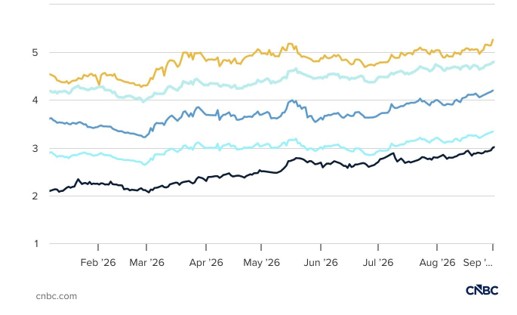
Source: CNBC
Two forces are compounding to drive yields higher. First, inflation fears are resurfacing, partly driven by rising oil prices tied to renewed conflict in the Middle East. Second, investors remain worried about the fiscal health of major economies—the U.S., Japan, and France in particular—given their elevated debt burdens. Adding to the pressure, central banks are widely expected to raise rates this month: the Fed chair struck a hawkish tone at Jackson Hole, the Bank of Japan may hike to prop up the yen, and markets are pricing in an ECB increase following fresh EU inflation data.
Equities have followed bonds lower, with U.S. indices posting three consecutive down sessions and European and Asian markets also declining—a reversal after a strong year driven by AI-related optimism. One asset management executive noted that rising borrowing costs reflect a broader repricing of risk, and warned that mounting global debt, without clear political will to address it, leaves markets vulnerable to future shocks even amid otherwise healthy growth.
This environment favors several classic playbooks:
- Macro/rates relative value: Steepener trades (betting long-end yields rise faster than short-end) or cross-country divergence trades (e.g., long JGB yields vs. Treasuries) become attractive as central banks move asynchronously.
- Short duration / short bond futures: Directional bets against sovereign debt, especially in high-debt-load countries (France, Japan, UK) where fiscal sustainability is in question.
- Inflation hedges: Commodities (oil, gold), TIPS, and breakeven-inflation trades gain appeal.
- Volatility strategies: Rising cross-asset correlation and equity drawdowns favor tail-risk hedging and long-vol positioning.
- Currency plays: Yen weakness vs. BOJ tightening expectations creates carry-unwind risk, a classic setup for macro funds trading JPY crosses.
The key risk for all of these: a “disorderly” repricing (sudden, sharp moves) can trigger forced deleveraging across risk assets, not just bonds.
End Notes