

Pricing Discipline Returns: NAV Discounts Narrow as Secondaries Market Matures
September 29, 2026
The global private equity secondary market reached a record $240 billion in annual transaction volume.1 Once seen as a niche avenue for distressed investors seeking deep discounts, the secondary market has become vital liquidity infrastructure for institutional portfolios.
A key trend defining this maturation is the shift in pricing dynamics. After years of wide spreads driven by economic uncertainty, net asset value (NAV) discounts have tightened across core buyout assets and continuation vehicles. As dedicated secondary capital grows and institutional adoption matures, secondary pricing reflects an increasingly efficient supply-demand equilibrium.
The secondary market has evolved from a niche, distress-driven corner of private markets into one of the industry’s most important liquidity and portfolio-management tools. Activity in 1H 2026 continued to accelerate across both LP-led and GP-led transactions spanning private equity, infrastructure, private credit, and other asset classes. While recent growth has been supported by a prolonged slowdown in IPO and M&A activity, the evidence suggests secondaries have become a durable feature of the landscape rather than a cyclical response.
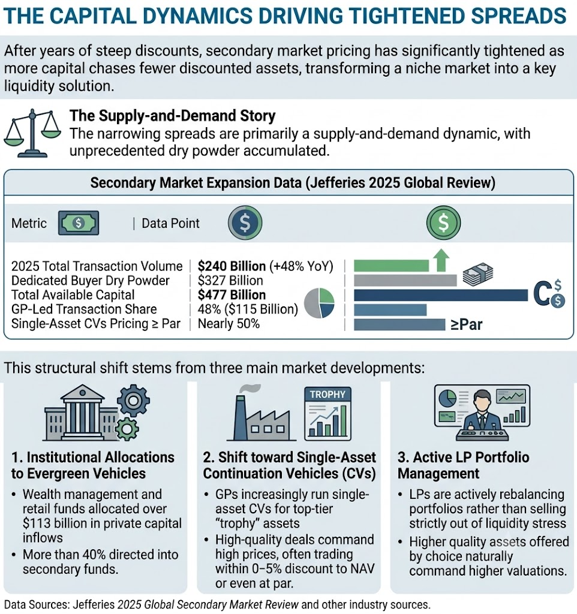
Image courtesy: Rostrum Grand research
The Capital Dynamics Driving Tightened Spreads
The narrowing of secondary pricing spreads is primarily a supply-and-demand story. Secondary fund managers accumulated unprecedented dry powder. According to the Jefferies 2025 Global Secondary Market Review, dedicated secondary capital reached $327 billion, with total available purchasing power (including leverage and institutional co-investment) approaching $477 billion.2
- Institutional Allocations to Evergreen Vehicles: Wealth management channels and retail evergreen funds allocated over $113 billion in private capital inflows, with more than 40% directed into secondary funds.
- Shift toward Single-Asset Continuation Vehicles (CVs): General Partners (GPs) increasingly run single-asset CVs for top-tier “trophy” assets. These high-quality deals command high prices, often trading within a 0–5% discount to NAV or even at par.
- Active LP Portfolio Management: Limited Partners (LPs) are actively rebalancing portfolios rather than selling strictly out of liquidity stress. Higher quality assets offered by choice rather than necessity naturally command higher valuations.
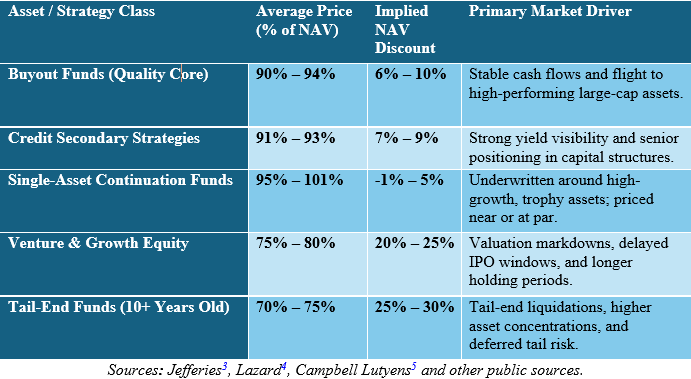
Comparative Secondary Pricing & NAV Trends
Pricing varies significantly across fund strategies, asset quality, and vintage age. High-conviction buyout portfolios trade near reported NAV, whereas venture capital and tail-end vintage funds face deeper structural discounts.
The table below illustrates recent secondary market pricing trends across major private capital strategies:
Source: Rostrum Grand research
What Narrowing Spreads Mean for Buyer Returns
For secondary buyers, narrower NAV discounts mark a transition in how returns are generated.
In previous market cycles, buyers relied on discount arbitrage, buying at a 20% discount and generating returns simply as marks recovered or distribution payouts occurred. As average discounts tighten to single digits on prime buyout assets, excess returns must be underwritten through operational growth and disciplined asset selection. For one, secondary buyers will have to stop relying primarily on deep discounts to provide margin safety. Returns will now be predicated on underlying EBITDA growth, multiple expansion, and above all, operating efficiency. Secondly, shorter holding periods become a real return vector. As a result, top secondary managers are utilizing structured solutions- such as deferred payments, preferred equity structures, and earnout provisions without overpaying upfront.
The narrowing of NAV discounts across private equity secondaries reflects a maturing market. While the era of easy discount arbitrage on high-quality buyout assets has receded, the secondary market offers liquidity, structural flexibility, and shortened return durations.
The new secondary-market playbook
The secondary market is therefore moving away from the “buy at a big discount and wait” model toward a more institutionalized underwriting framework.
For investors, this means the headline discount to NAV is becoming a less complete measure of expected return. The more relevant questions are: How credible is the NAV? How quickly can it convert into cash? What is the quality of the underlying portfolio? What distributions can be expected? And what additional return can be created through structure or asset-level value creation?
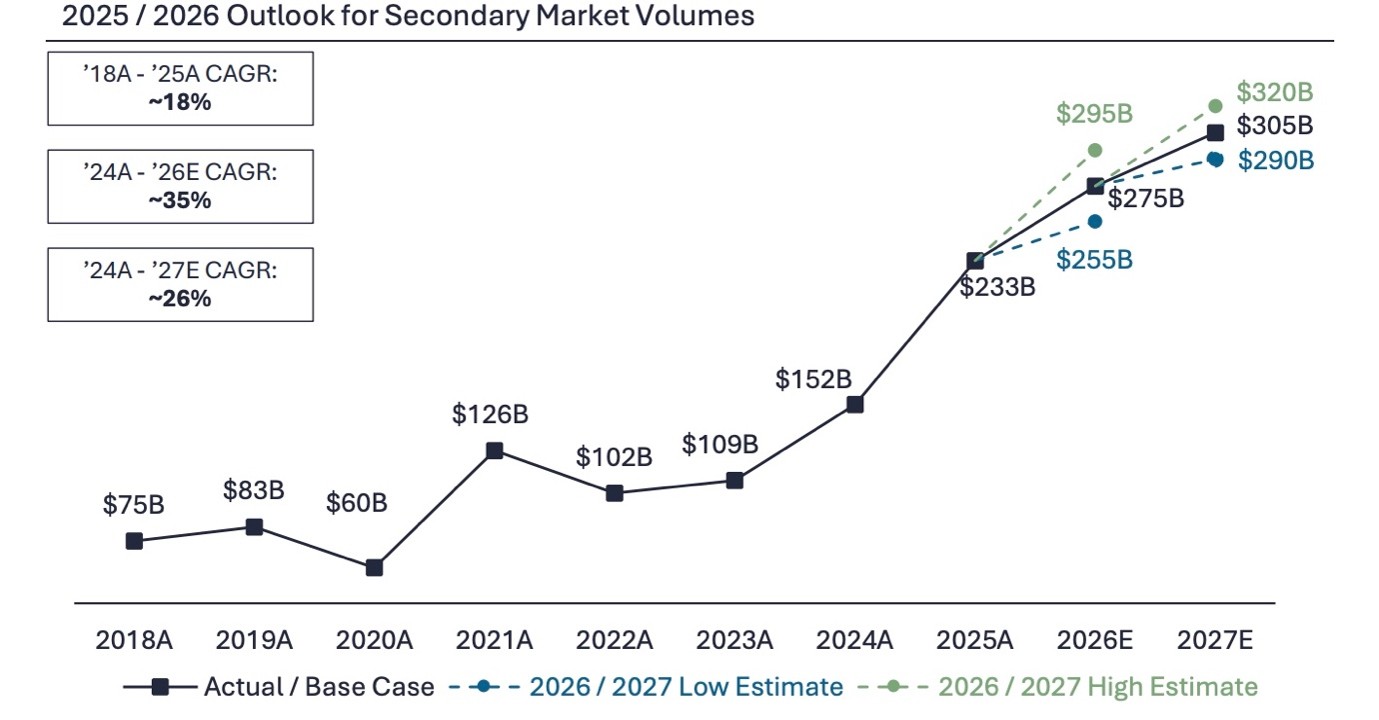
If 2025 saw impressive growth, the next two years are expected to sustain the momentum. According to Lazard, growth on the upper end is likely to edge closer to $300 billion in 2026 and $320 billion by 2027.
 Source: Lazard 2025 Secondary Market Report6
And so?
Going forward, outperformance in the secondaries market will belong to managers who combine data-driven asset selection with operational underwriting, proving that pricing discipline remains vital as secondary volume scales toward $300 billion.
For investors, the implication is that headline discount to NAV is becoming a less complete measure of expected return. The more relevant questions are: How credible is the NAV? How quickly can it convert into cash? What is the quality of the underlying portfolio? What distributions can be expected? And what additional return can be created through structure or asset-level value creation?
Expect continued bifurcation rather than a uniform re-widening or re-narrowing. Quality buyout and single-asset continuation vehicle pricing is likely to stay tight as capital keeps flowing toward the safest, most liquid deals, while tail-end and venture positions will keep trading at meaningful discounts because capital isn’t chasing them as aggressively. For buyers, the practical takeaway is that secondaries pricing discipline is real, but it rewards selectivity – the days of a rising tide of cheap NAV lifting every secondaries buyer’s returns appear to be over
As the secondary market matures, pricing discipline is returning to the center of the investment process. The easy returns generated by market dislocation may be harder to capture, but a deeper, more analytical market could increasingly reward investors who can distinguish between a cheap asset and a genuinely mispriced one.
Sources:
3. Ibid.
4. https://www.lazard.com/research-insights/lazard-2025-secondary-market-report/
5. https://campbell-lutyens.com/news-insights/publications/2026/2025-secondaries-market-flash-report/
6. https://www.lazard.com/research-insights/lazard-2025-secondary-market-report