

Quant Crowding and the Next Flash Event: Lessons from Recent Factor Unwinds
September 5, 2026
Systematic investing was supposed to be the antidote to herd behavior. Strip emotion out of the decision, run it through a model, and you get discipline where human traders get panic. Three flash events – separated by almost two decades but built from the same mechanics – show why that promise keeps breaking down.
Some Examples first:
During the week of August 6, 2007, dozens of quantitative long-short equity hedge funds –many with strong long-term track records – suffered unprecedented, simultaneous losses, ranging from 8 % to 18% in a matter of 48 hours1. Academic research later showed the losses were not driven by a market-wide shock but by the forced liquidation of one or more large, similarly constructed quant portfolios, likely triggered by a margin call or risk-reduction decision at a single large fund or trading desk.2
Another case study is the summer 2025 “quant wobble.” Sophisticated long-short equity managers ground through weeks of losses that Goldman Sachs’ prime brokerage unit pegged at roughly 4.2% for the period, with much of the damage attributed to short books rather than long positions, Reuters reported.3 MSCI’s factor-model postmortem went further, finding that unusual correlations across the beta, profitability, momentum and liquidity factors – beyond what linear models would predict – pointed to a systematic unwind of crowded factor positions, not simply bad stock-picking.4
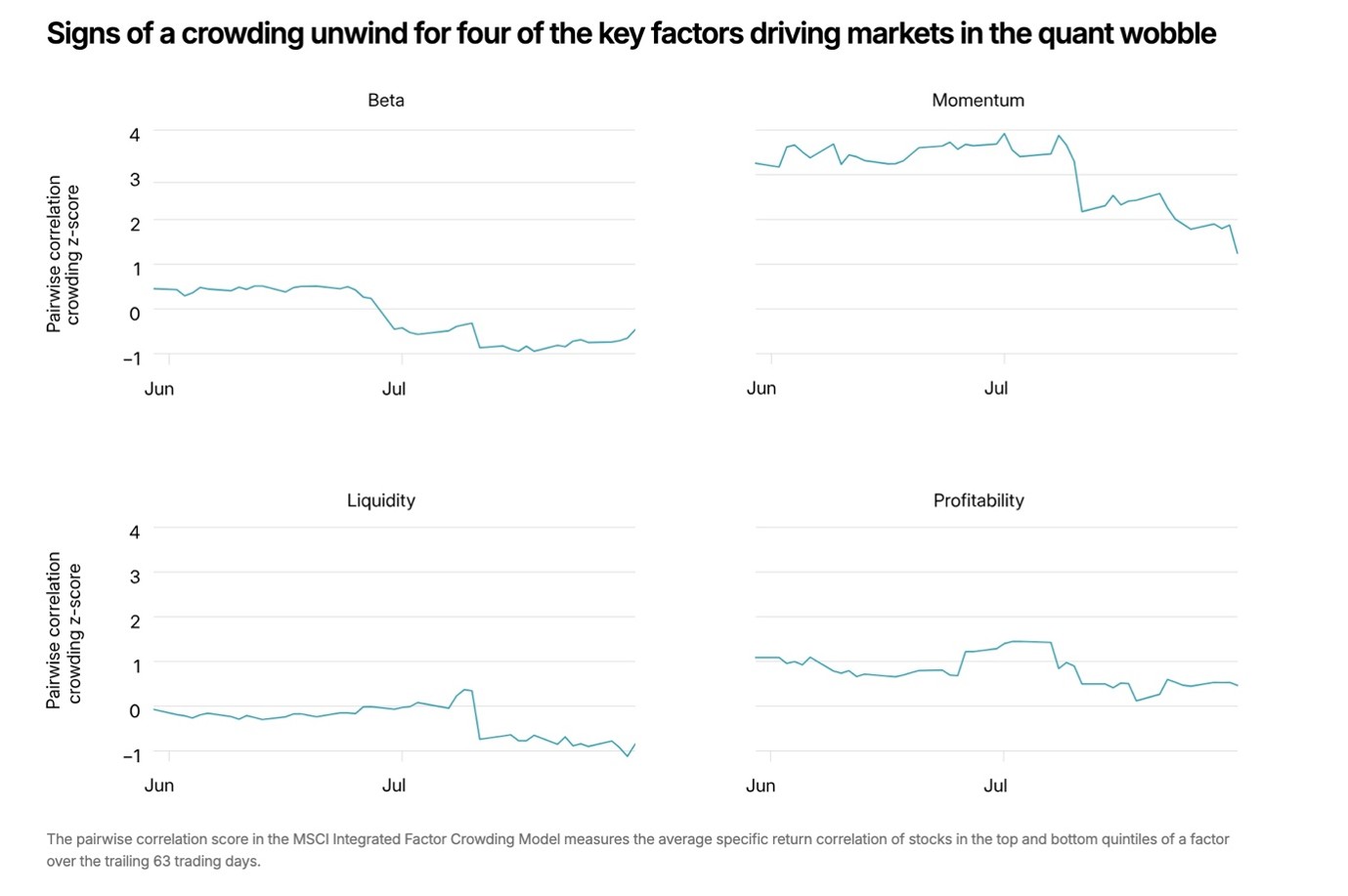 Source: MSCI Research5
Cut to July this year. Situational Awareness, an AI-thesis fund built on leveraged bets in AI infrastructure and chipmakers, was forced to sell its entire public equities book of roughly $16 billion in a single block trade to cover losses after a single chip stock fell 47% in a week.6 This forced sale hammered the very stocks that the fund had been long, then triggered a sharp reversal once the clearing event had passed.
The same mechanism, twenty years apart
Strip away the asset class and the decade, and the three events rhyme almost exactly. In both cases, a single large, leveraged, factor-concentrated portfolio became a forced seller. Situational Awareness under margin calls from its prime brokers, the 2007 quant funds under margin calls, or an internal risk-reduction mandate. In both cases, forced selling landed disproportionately on names many other systematic or thesis-driven portfolios also held, because crowding around a small set of popular signals (AI infrastructure exposure in 2026, value and momentum factors in 2007) meant one fund’s exit became everyone else’s markdown. In both cases, prices recovered substantially once the liquidation was absorbed, confirming the damage was a positioning unwind rather than a genuine change in fundamentals.
The problem wasn’t any single bad bet. It was structural overlap. Research on the period found that among the most heavily shorted names, nearly half carried heavy exposure to residual volatility, and once you included other factors like high liquidity, high beta, low profitability, small size, or low momentum, the share of overlapping names jumped to 84%.7 This essentially meant that almost every systematic short book with meaningful exposure to those characteristics was standing in the same trade.
This was not an idiosyncratic exit, but a coordinated one.
Risk management lessons that remain unlearned
Leverage magnifies correlation, not just losses. Situational Awareness’s 4x leverage turned a painful-but-survivable drawdown in one position (SK Hynix) into a forced liquidation of an entire book. The 2007 quant funds were similarly leveraged relative to the capital backing their factor bets. Leverage doesn’t just make losses bigger; it compresses the time available to de-risk in an orderly way, which is precisely what turns an ordinary drawdown into a flash event.
Crowding is invisible until someone is forced to sell. No single manager in either episode could see how many other funds held the same exposures. Khandani and Lo’s research on the 2007 episode argued that elevated, unexplained correlation across supposedly diversified quant books is a warning sign worth monitoring in its own right — not just a footnote for post-mortems.8 The same blind spot applies to AI-thesis concentration in 2026: dispersed capital had quietly converged on the same infrastructure trade.
Genuine liquidity reserves matter more than mark-to-market cushion. A recurring conclusion from the 2007 episode is that the funds that came through with the least damage were those holding real, undeployed cash and not just liquid positions valued at market prices that evaporate the moment everyone tries to sell at once. A margin call doesn’t care what a position was worth yesterday; it cares what can be raised today.
Forced unwinds create the best entry points for those with capital and patience. In both cases, the panic selling created a clearing event that resolved relatively quickly for the broader market; Citadel picked up Situational Awareness’s book at depressed prices, and equity factors mostly recovered by August 10, 2007, i.e, in the next 48-72 hours. The lesson for risk managers is less comforting than it sounds: knowing that unwinds tend to reverse doesn’t help the fund doing the forced selling, and it rewards exactly the concentrated, well-capitalized players who can step in — reinforcing, rather than reducing, the concentration that caused the problem in the first place.
Two decades of nearly identical case studies suggest the lesson isn’t obscure. It’s that overlapping exposure, thin liquidity buffers, and leverage keep recombining into the same flash-event shape, and each time, the market treats it as a surprise. Allocators should be demanding real exposure transparency in terms of factor, sector, and crowding diagnostics, rather than accepting “it’s diversified” as an answer. Until that becomes standard due diligence rather than a post-crisis talking point, the next flash event is less a possibility than a scheduling question.
Conducting post-mortems after taking a massive haircut is an odious business.
Sources:
1. https://quantdecoded.com/en/crowding-quant-strategies-detection-risk
2. https://www.nber.org/papers/w14465
4. https://www.msci.com/research-and-insights/blog-post/unraveling-summer-2025s-quant-fund-wobble
5. Ibid
6. https://finance.biggo.com/news/5c86c78e-ff94-407c-8e56-551fe51d4b57
7. https://youngandcalculated.substack.com/p/why-so-many-quant-funds-blow-up
8. https://www.nber.org/papers/w14465